


Fintech Review 2025: AI Risk Becomes Banking
Updated: 1 hour ago
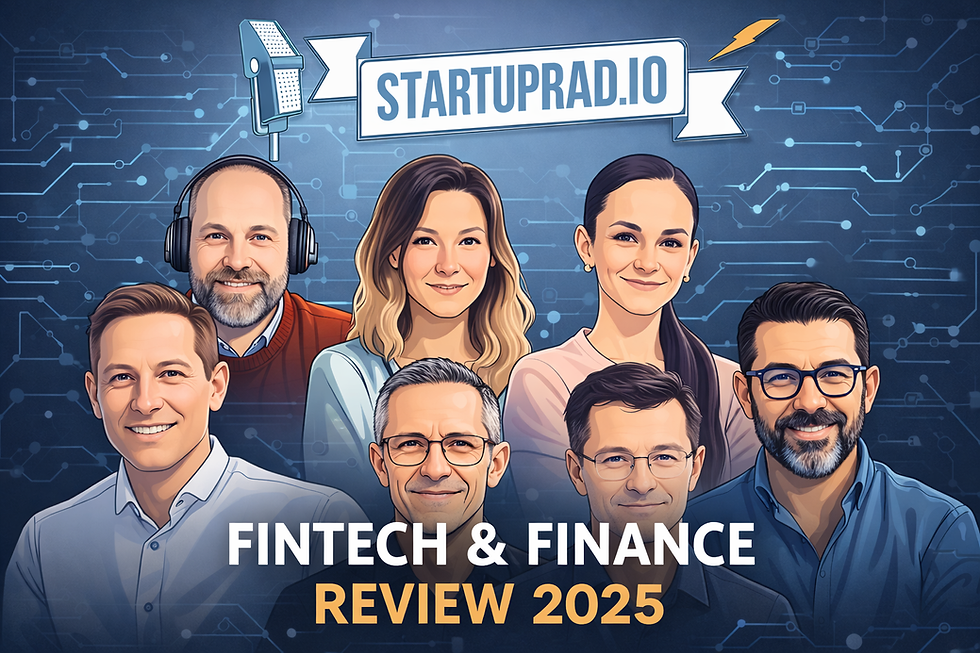
What Is This About?
The 2025 Fintech Review reveals that AI in credit is now irreversible — enforcement-era regulation is rewiring cost structures and strategy across the DACH financial sector. This annual analysis maps where fintech is heading as AI becomes embedded banking infrastructure rather than an experimental tool.
Introduction
The 2025 fintech landscape has been reshaped by two irreversible forces: AI-driven credit decisioning and enforcement-era regulation. This comprehensive fintech review covers how these trends are rewiring cost structures and strategic priorities across Germany, Austria, and Switzerland. For fintech founders, investors, and banking executives, this episode serves as a decision reference for building resilience into financial technology businesses during a period of fundamental industry transformation.
The 2025 DACH fintech landscape is defined by two irreversible trends: AI-driven credit decisioning becoming standard practice and enforcement-era regulation fundamentally rewiring cost structures. Banks and fintechs that haven't embedded AI into core lending processes face growing competitive disadvantage as AI-native competitors offer faster decisions at lower cost. Regulatory enforcement actions have shifted from warnings to meaningful penalties, making compliance a strategic priority rather than a checkbox exercise. The review identifies which business models are resilient under these conditions and which face structural decline.
AI in credit is irreversible; enforcement-era regulation rewires cost and strategy. This is the decision reference for fintech resilience in 2025.
AI in credit is irreversible; enforcement-era regulation rewires cost and strategy. Startuprad.io brings you independent coverage of the key developments shaping the startup and venture capital landscape across Germany, Austria, and Switzerland.
This founder interview is part of our ongoing coverage of Scaleup Founder Interviews from Germany, Austria, and Switzerland.
Finance is entering an irreversible phase: AI becomes a risk-managed infrastructure layer, real-time rails eliminate latency tolerance, and regulation shifts from consultation to enforcement. Winning institutions treat governance and resilience as product reality, not paperwork.
AI in credit becomes irreversible because processes, auditability, and real-time expectations rewire around it; removal breaks operations.
AI risk management becomes a bank-wide job because probabilistic systems fail differently than deterministic software.
Concentration risk makes AI systemic; shared model dependencies propagate failures.
DORA forces third-party and resilience discipline, but marginal regulation is drifting into bureaucracy.
Insurance automation fails when it increases contact; self-service that avoids contact wins trust.
Tokenization matters when it shifts control of settlement and access, not when it only improves UI.
Why AI in credit decisions becomes irreversible
Once AI sits inside credit decisions, it becomes a dependency of underwriting, monitoring, and audit. Removing it breaks speed, controls, and comparability.
AI alters the workflow: data collection, decision logic, and exception handling change shape around the model. Even “human override” becomes model-conditioned.
This is stated explicitly as irreversibility: AI enters core decisions and does not come out.
AI governance shifts from correctness to risk envelopes
Probabilistic models cannot be governed like deterministic software. Governance becomes bounded misbehavior with monitoring, escalation, and kill-switch design.
Agentic systems compound risk because outputs are nonlinear combinations of models and tools. Validation shifts from single-model accuracy to system-level failure modes.
Paolo Sironi frames the cultural shift: risk management must exist at all levels for AI to scale.
Regulation is now a business model filter, not an obligation
When regulation moves from consultation to enforcement, it selects business models by operational capability and cost base.
DORA’s core logic is rational: third-party and infrastructure risk must be controlled. The risk is diminishing returns: excessive detail becomes bureaucracy with limited added value.
Frank Schwab distinguishes meaningful governance demands from excessive regulation density.
Trust is the limiting factor for automated finance
Automation scales only if outcomes are trusted. In insurance, the highest-signal design is self-service that avoids customer contact.
“Better support bots” misdiagnose the problem. Customers want intuitive flows that prevent escalation. Automation that forces interaction feels like friction and reduces trust.
Meeri Savolainen states the discovery: users want not to open chat at all.
Tokenization matters when it shifts control of infrastructure
Tokenization changes markets when it reshapes settlement, access, and control layers. Efficiency gains are secondary.
Private credit tokenization can alter secondary liquidity assumptions and democratize access, but only if market structure and compliance enable real trading, not only representation.
Multiple guests point to tokenization’s acceleration and underpriced impact on private credit and market access.
Inline Micro-Definitions
AI irreversibility
Operational dependence that makes removing AI break process, auditability, or latency constraints.
Probabilistic governance
Controlling bounded failure behavior rather than expecting deterministic correctness.
AI concentration risk
Systemic dependency created when few model providers power many institutions.
Self-service insurance
Customer experience designed to resolve needs without contacting support.
Tokenization
Representing assets as digital units for transfer and settlement, with implications for access and control.
Operator Heuristics
Treat AI as risk infrastructure, not a feature.
Measure concentration risk before scaling deployments.
Govern failure envelopes, not model “correctness.”
Remove customer-contact steps before adding automation.
Fund compliance as strategy constraint, not overhead.
Underwrite recoveries, not only defaults.
WHAT WE’RE NOT COVERING
We exclude funding rounds, product launches, and vendor comparisons because they do not change governance requirements. We exclude generic “AI disruption” narratives because decisions in finance are constrained by enforcement, latency, and trust. Omission signals the only relevant layer: structural constraints.
Relationship Map
Jörn "Joe" Menninger → Host of → Startuprad.io
Automated Transcript
1 Welcome to StartUpLead IO, 2 your podcast and YouTube blog covering the German 3 startup scene with news, interviews and 4 live events. If 5 you're trying to understand where finance is actually heading, 6 not what's trending on LinkedIn, not what's being 7 pitched, but but what is structurally 8 changing underneath, this is the 9 episode for you. 2025 10 was a year of contradiction. AI 11 moved from experimentation into underwriting, fraud 12 detection and core operations, while 13 regulators simultaneously tightened expectations 14 around explainability, resilience and risk. 15 Banks reported stability, yet quietly 16 restructured cost basis and exited entire value 17 chains. Fintechs spoke about growth again, 18 but under very different unit economics. 19 What made this year different was not speed, it was 20 irreversibility. Once 21 AI is in credit decisions, it doesn't come out. 22 Once instant payments become mandatory, latency is
23 no longer tolerated. Once regulation moves from 24 consultation to enforcement, business 25 models either adapt or disappear. In 26 this Fintech and Finance Review 2025 we stop back 27 from the noise and ask a more fundamental question. 28 What still matters in finance? And what quietly 29 stops mattering next. Hello and welcome. This is 30 Joe from StartupReady IO and you're listening to and 31 watching our Fintech and Finance Review 2025. 32 This is a tradition we kept every year since 2014, 33 not as a recap of products or funding rounds, but 34 as an editorial checkpoint. A 35 moment to pause and ask what was fundamentally shifted, 36 what assumptions no longer hold and which debates 37 will still matter 12 to 24 month 38 from now. This year those 39 questions feel heavier. 40 Interest rates are no longer a temporary condition, 41
AI is no longer side project and regulation from 42 DORA to PSD 3 to M is no longer 43 theoretical. To make sense of this, 44 we've brought together a careful curated group of 45 voices. Global banking research board level 46 governments, founders operating in credit and insurance and a 47 global perspective on blockchain and tokenization. Each 48 guest answered three focused questions, one on 49 structural change, one on execution and risk, 50 and one forward looking outlook toward 2026 51 and beyond. What's striking is that these 52 conclusions weren't planned. They surfaced independently 53 across very different roles. Let's begin with the 54 widest possible lens, the structure of banking itself. 55 To understand where banking is structurally heading beyond 56 products and platforms. We start with Paolo 57 Cironi who looks at finance as a system, not 58 as a set of technologies. I would like to welcome Paolo, the
59 most frequent guest at StartupRight IO. Thanks for having 60 me here every year and Happy Christmas to all of you. 61 Exactly, Paolo. The financial 62 industry is being redesigned re. 63 Architect by Open Finance AI and higher interest 64 rates. Which parts of the the banking's value. 65 Chain will still matter in 10 years. And which 66 ones will vanish? Well, I guess 67 that high interest rates that think that might vanish in 10 years 68 from now. That was. 69 But I guess there is a federally secular trend about interest rates 70 and everything is conjuring also for this period to be 71 unsustainable. But it's a very very 72 interesting question if I can say 73 2025 I see this but was the first year 74 when regulation went faster than the industry 75 because the Genius act created 76 a huge if you like discussion and
77 set of opportunities started from the US 78 about the tokenization of value 79 and money. So I guess a lot of banks got 80 surprised off guard on the fact that now that there is a 81 framework the players outside financial 82 services can act even more swiftly and 83 broadly which is igniting a lot of if you 84 like implementations or healthcare competition. And that I think was 85 surprising for everybody. This typically the industry moves although 86 the fintech are pushing the boundaries and then the regulators try to 87 understand them and the job policymakers. But this time around 88 I guess it's very different now. Still 89 unclear to know whether the tokenized economy will 90 be effectively unfolding the properties that 91 many commentators are discussing. But 92 definitely there is a strong acceleration. It's no surprise 93 that my next research will be about banking in a
94 tokenized economy. 95 Of course there's no way around talking. Technology and 96 resilience here, especially AI. I do 97 believe that was a buzzword of last few years. 98 Banking is quite data intense 99 building is AI helping here in this 100 data intense environment, highly regulated environment 101 in banking, fintech. Capital markets and also maybe in insurance. 102 Is this helping to build a safer system or 103 is it quietly increasing fragility? 104 Well Jon, just 105 a few days ago Anthropic released a 106 very interesting yet concerning report 107 titled Disrupting the first reported AI 108 orchestrated cyber espionage campaign. 109 Essentially what happened is that an AI 110 framework hacked the cloud code model 111 using that model to basically understand the 112 potential security vulnerabilities of a set of companies in 113 financial services, in chemicals, in government, 114 among others. I think the number was 34 firms
115 and then use a code in an automated fashion to 116 basically penetrate, get IDs, 117 passwords and then steal data and piece of information. 118 And of course anthropic managed to detect very fast 119 the threat and they to use their own AI to basically 120 diffuse the capability of another AI that was tricking their own AI. So we 121 have this example of an AI framework 122 that is a set of AI agents that 123 socially engineer an AI model 124 pretending to be somebody else, tricking that AI 125 model to act in unwanted ways beyond their 126 guards race helping them as an ally inside the organization 127 to basically scout information that otherwise would have been 128 difficult or would have taken days, weeks or months 129 to be generated. Because the automation of AI is 130 incredible. And the flexibility that apparently these AI
131 agents orchestrated by these rock traders 132 was truly remarkable. And therefore 133 anthropicator. To deploy their own AI to understand the 134 trickery of an external framework onto their own AI is like crazy if 135 you think about it. So, which spans a couple of considerations. 136 The first, since a couple of years I've been insisting 137 in my research that every banker must be an AI risk manager. 138 So whatever you do, you always need to understand 139 all of the intricacies of this new framework, 140 because there are many and they cannot be forgotten. And then the 141 second is always difficult for security folks to 142 basically do their job because you're really never 100 143 secure in a sense, right? So it's like 144 a process where you have to continuously fight to be the best. 145 It's like you need to be the fastest racers while all the others are
146 accelerating, you know, getting new shoes, you know, to run those hundred 147 meters faster than you. They get a new diet and whatever. So that's very, very 148 complicated, but it is feasible. And all in 149 all, it is also about the architecture, because it 150 probably goes down into the dungeons of how you design your every cloud 151 perspective to make sure that on top of security, 152 you also have your secure, the design at the core 153 of everything. And so next year, 154 I believe that as the first 155 AI agents will be deployed by 156 quite a number of institutions for a broader 157 utilization. It is also the year where we have to see 158 how cybersecurity stepped up in order to 159 protect that framework from its 160 own deficiencies. And if I can 161 conclude, the issue is also the fact that we are
162 all running towards an upper concentrated 163 AI world, right? So remember I wrote a paper for Davos two 164 years ago and was discussing the problem of concentration. 165 You have a few large companies that create 166 models, and not only if one of those models misbehaves, 167 that can have, you know, viral crippling effect across 168 entire economies, but now we also have 169 the possibility that some of them becomes too big to fail. 170 Right? So there's a lot of unwanted consequences in 171 the last two years of the AI race. They 172 must be thought through. I, I do believe the future is for 173 smaller models, so they will create more resiliency. 174 But that future is yet to come. While we are all building 175 on this existing concentration where one single 176 point of vulnerability can generate the vulnerability for all.
177 So that. If 178 I take something from. You, just, just one sentence from Today's 179 Fintech review it's every banker needs to. Be an risk 180 manager. That, that's an amazing. 181 So everything because the history of investing in technology 182 and adjusting banking is investing in technology. That is more and I use the word 183 deliberately unstable. That is a way of saying a flexible 184 and powerful light. Because when technology is very 185 deterministic it can do all a set of things right. And, and all those 186 things. But AI is way more probabilistic. 187 Generative AI is definitely probabilistic where you have to deal with instability 188 of the algorithm as well as the one of the human interact with the algorithm 189 in language mode and agentic AI is way more right. 190 Because you have the orchestration of multiple agents and multiple models
191 and the way they combine themselves one with the other is 192 nonlinear. So you don't validate anymore the individual models, but a combination of the 193 models and that compounds the complexity to understand the 194 potential misbehavior. So if you don't have a stronger risk management 195 understanding of how this algorithms work and where 196 the potential threat can come from, things can be 197 overlooked pretty fast. And in the age of AI, 198 if you overlook something, the velocity by which can be exploited them 199 is unprecedented. Right. So that's why I insist that the major 200 cultural change that has to happen in an 201 organization to allow AI to scale enterprise wide 202 is there is management of AI at all levels of 203 the organization to prevent than to manage. 204 Because it's about being capable of managing probabilistic 205 technologies like the 13th floor. The fact that the models are not perfect is not
206 the point. The point is can you risk manage those models right. And if you 207 can do that, you can be successful in capital markets. And the same is with 208 technology. If you can risk manage technology, it's no problem. You can 209 use technology. 210 We're not only looking back at 2025 and the last few years, 211 but we're also looking at 2026. And Bey, 212 do you say in your personal opinion, what's the one fundamental change 213 in global finance or fintech capital markets 214 that almost nobody sees coming for 2026 and beyond? 215 Well, it's different that somebody doesn't see something because everything 216 is so highly discussed. 217 Okay. And, and, and debated. 218 So I don't know. I, I think that 219 the banking industry is starting to reposition from 220 the business side as well as 221 the geographies are somehow
222 reshuffled. So the American 223 banks have been gaining strength. 224 Although the Europeans got the benefit of the rise of interest 225 rates from the last two years and the American 226 banks, some of them had 10 years to 227 invest into building the foundations, to 228 engage clients on the continuum of client wealth, where for 229 the first time we see that the channel is more important 230 than the segment. So you may need or want to capture 231 someone across everything that can happen on the channel because the 232 channel becomes a platform. And many people may not have realized 233 that, but this has been happening and going on. You can think 234 about what companies like 235 JP Morgan are doing or Morgan Stanley 236 and I think the world is round. But we're here in Europe talking about that. 237
We know the JPMC also tried to make a road in the 238 German market. So will be interesting to see if 239 the next year is the year where maybe 240 through further developments of stablecoin, the 241 capability of American banks to 242 penetrate the European market gets intensified 243 or not. So that is the thing that I 244 guess people might have overlooked. So we're not just talking about 245 technology for technology, tokenization for tokenization. The 246 question is, is this giving more levi or power 247 to some of the players that have invested them in the traditional 248 market now refresh with technology to make those 249 inroads and advances that they always 250 dreamed of. And maybe we 251 will see that in 2026 or 20. So I would 252 point out at the JP Morgan retail bank going to 253 launch 2026 in Germany as one of the indicators here.
254 Paulo, with such a pleasure having you here as guests. Thank 255 you very much. It is always my pleasure to be 256 here and for all those that are 257 attending and as many here on your podcast. I just 258 realized that my business title is a German word which 259 justifies the federal living in Germany. Because when people ask me, Paolo, what do you 260 do? I always say that I am the global research leader in banking and 261 financial markets at the BM Institute for Business Value, which in German 262 is a simple word. Happy Christmas 263 to all of you. Paolo describes finance 264 as architecture value chains, dependencies and 265 concentration risks. But systems don't run 266 themselves. Someone decides which risks are 267 acceptable, which investments get funded and which 268 legacy assumptions are abandoned. 269 Those decisions happen in boardrooms under regulatory
270 pressure with incomplete information. That's where 271 governance moves from theory to reality. 272 If structure is theory, governance is reality. 273 And Frank Schwab brings the board level perspective on what 274 banks can still win and where they are structurally 275 constrained. Welcome. Thank you. 276 It's an honor to be here here after year. So I 277 really enjoy it. Me too. As 278 you got in the recording studio, I said, so we beat again this 279 year. Always shortly before Christmas. Very glad to have you 280 here. Let us dive right in. Where 281 can traditional banks still win against fintech and 282 big tech? And where Are they structurally 283 unfit to compete? I 284 believe, let's say the banks with the really big 285 balance sheets, they still have 286 significant advantage over all other players 287 just due to the fact that they have so much
288 assets and so many and deep customer 289 relationships which hold for decades. 290 So I don't think that these bank giants 291 have to fear competition from FinTech or BigTech. 292 On the other hand, that's quite different for small 293 and very focused 294 banks. So if you are a small bank or a mid sized bank, 295 the competition you basically feel on a daily 296 business and if you have a limited scope 297 in terms of product, services and customer 298 groups, then it's pretty important that 299 the area which are you populating the area 300 you sitting in the competitive, let's say 301 landscape that you are actually best in class 302 in order to survive. Actually, when you've been talking about 303 this, I had in mind on the one end you have 304 the very fine banks who are serving 305
certain customer families already for 306 decades. And on the other hand you have somebody 307 in the B2C space that has the 308 longest banking history with N26. So I think 309 there's a lot of in betweens, right? Yeah. And 310 also from a business model complexity. So the business 311 model of N26 is quite 312 simple. Right. It's a retail 313 customer only, it's a limited set 314 of products. Let's say 315 if, if you are a traditional bank, 316 let's say small 317 savings banks or small union banks, 318 which basically have the same 319 kind of, let's say, product portfolio 320 and focus, they can't survive. 321 And we have seen that over the last, let's 322 say four decades the, 323 the number of savings 324 banks and union banks, not only in Germany, the same is 325 true for let's say almost every any other
326 mature country, they decline 327 by 50%, 60% up to 328 80%. So what 329 you see, what's left over is the 330 one who did excel in merging, acquisition and 331 building a significant customer base, a significant 332 balance sheet. If you look at Spain, 333 there are only two CAR shares, so savings 334 banks left, right. 335 And therefore that's what we 336 see. Simple business model, 337 unbelievable competition, complex 338 business model, complex business, complex customer 339 structures and huge, let's say 340 balance sheet that's much more 341 difficult to attack and much more difficult to copy. 342 You have a broad business base, you have a broad 343 client base, you do have economies of scale and so on and so forth. 344 I do understand that when you've been talking, just to tease 345 you a tiny bit here, and I know forecasts are always
346 difficult, especially concerning the future. Do you think that at one 347 point in Germany we'll end up with two savings banks 348 to Sparkassen and two union banks meaning Volksbank and 349 Reif Eisenbach. Like two big, like four big players 350 out of hundreds before. Yeah, yeah, 351 yeah. Probably not in 352 my lifetime but. 353 But I. That's bad that, that, that's. 354 Look we have seen 4,000 355 savings bank going down to less than 356 400. I think we are now in the 357 360 or 70. So that's, that's 358 where we currently are. 359 There is no reason why should this should stop. 360 And you know there was was always a discussion about 361 Landespunk. Why do we have more than one Landesbank? 362 And it's a fair question. And 363 anyhow, why do you have a central bank? Because the
364 Landes bank somehow central banks for, for savings banks 365 they also cover a different kind of business. 366 But let's say the question is why. Right. 367 So will we end up like that 368 100 years from now? Probably. On 369 the other hand other players, new players will 370 have emerged and they will be established 371 which we never heard of before. And now part 372 of the landscape. And also let's say 373 lately banking licenses are granted again and again 374 and again and again for these new players. And 375 so the landscape is changing 376 and evolving. I, 377 I believe there is still place for, for savings banks and union 378 banks but not in the, 379 in the form which they were 380 successful in the past. So success in the past 381 does not guarantee your success in the future. And, and that's
382 pretty clear if you look at the, at the, at the 383 structure of than the individual bank. 384 Sounds like an investment brochure. Past performance is no indicator 385 of future performance. I see. Let us shift a little bit 386 perspective. From your board perspective, are we seeing 387 smarter governance? Are we seeing just heavier 388 bureaucracy under DORA and Basel iv? 389 So there are two hearts. So if I look 390 for example at dora, 391 what regulation ask for makes a lot of sense? 392 So for example they ask for let's say 393 assessing third party risk and critical 394 infrastructure providers. Right. So 395 that's actually, actually 396 it's sad that it needs a regulator 397 to ask the banks to fulfill that. 398 If you run a business I would argue you should run it 399 in the proper way. And in the proper way is that you fall in control
400 what you have outsourced to a third party. But unfortunately 401 that's not necessarily actually the case. So therefore 402 there is a lot of regulation. If you look at the 403 core of it, that makes a lot of sense. 404 And if banks don't do it by themselves, you 405 actually need to do it and you need to regulate it. On 406 the other hand I just published an article 407 over the weekend having 408 last week more than, more than 10 different board meetings and 409 committee meetings. And my conclusion by 410 now is there 411 is too much too detailed 412 regulation and currently it ends up and 413 it feels like significant bureaucracy. 414 So the challenge for the banking industry 415 and especially for the regulator is. 416 How. Much regulation do you actually 417 expect and how much value 418
does regulation create? 419 Because as a society 420 we cannot afford regulation which we, 421 which, which doesn't pay out right? So, so if it ends 422 up in bureaucracy with almost zero 423 additional value, then additional regulation 424 does not make any sense. I totally agree with that. 425 Let us look a little bit into the future. We have the strategy 426 with the board view and regulation and now let us 427 shift in to 428 looking into the future just a little bit. Not, not the hundred years we did 429 before. What shift in banking or 430 regulation do you think most 431 executives will be blindsided by in 432 2026 and beyond? I'm not, 433 I'm not sure whether any executive will be 434 blindsided because let's 435 say according to, to my exposure, 436 I'm not aware of any 437 traditional bank manager who is not
438 trying to comply to all the regulations and, 439 and, and beef up and step up in 440 skills and people and functions 441 in order to make a the bank full 442 compliant. That's quite different 443 for fintech startups and 444 new players into the industry and you actually can see 445 that in the amount of fines which are 446 especially now awarded to, to 447 new players like N26 448 but lately also Revolut or Trade 449 Republic. So you will see a lot of 450 these new entrants into the banking 451 sector who do not 452 cope successfully with the, 453 with regulations and compliance. So the 454 blindsided is more to the new to the industry 455 than to the established industry 456 from all I can see. Totally agree. 457 Do you think there is a regulation 458 that all regulations are known?
459 Just assume that. I think in normal banking that's pretty fair 460 assumption because they do have a lot of people working on that 461 with implications how deep you need to go, how, 462 how much implication in your daily business 463 it has. Do you think there's, there's something out there 464 that banks don't really see right now from your experience or do you 465 think they have a pretty good handle on all of. No, it's not about 466 that. They don't see it that, that I 467 cannot experience. But what happens from. 468 So first of all, most bank managers 469 will tell you the same thing. They spend the more senior 470 you are. It feels like you spend 471 80% of your time and your money, 472 your discretionary money on regulations. 473 So these days, which is an unbelievable 474 High percentage. Right.
475 So, so, so and many people and many figures 476 will, will, will support that, that view. 477 How deep and let's say being surprised, 478 sometimes you are surprised how fast a regulation 479 comes. That sounds strange in Europe, 480 but for example, if you are a 481 banking manager in Eastern Europe, then 482 some of the parliaments 483 they approve a law which has to come into, 484 let's say place in, within nine 485 to within six to nine months 486 and that's in, in banking terms pretty fast if you need to 487 comply within nine months to a new 488 regulation and therefore that 489 sometimes where you are caught by surprise. 490 But that's more on a very local 491 and also non European regulation, 492 European regulations from ipa, 493 ECB and others. You're not really surprised 494 because the discussion often is for years.
495 At some point in time you may be surprised 496 by the details which are then decided in the 497 last minute so that you do not have the 498 proper time for specification. 499 But on the other hand, I believe from 500 all I can see that banks in general, banks and regulators, 501 they work together in a way that, 502 let's say in a proper way. Right, In a good way. 503 So most of the time this is 504 not an issue and nobody is really 505 catched by any surprises in a significant 506 way. Yeah. We may discuss, let's say 507 for example, all the ESG 508 details, if they make sense for each and 509 every institution or if we need 510 to look at let's say proportion. So 511 meaning, let's say what's relevant 512 and important for a large 513
wholesale bank may not necessarily 514 be useful and does not make much sense 515 for a small retail bank. Right. So, so, 516 but, but still you have the same regulation and, and therefore 517 let's say that that's something 518 regulators identified as an issue. 519 They also said they work on it and 520 we will see what then 521 brings us in the next years. But I do not 522 see any significant regulation 523 which will catch up by surprise. 524 Frank, thank you very much. Was a pleasure again talking to 525 you. Looking forward to have you on next year 526 again in our fintech review. Thank you very much. 527 Thank you Jern. And happy New Year to all 528 the people out there. Thank you. Governance 529 may look rational from the inside, but it is judged 530 from the outside. Media narratives,
531 public trust and political framing increasingly shape 532 how much strategic freedom banks and fintechs actually have. 533 To understand that layer, we need to look at how the story of fintech 534 itself has changed. Because 535 finance doesn't evolve in a vacuum. We add the media 536 and narrative lens. With Jacob Ward, who has spent years 537 translating technology shifts into a global audience. 538 Thank you so much John, for having me. I really appreciate it. 539 My pleasure. Let us dive right in. How has 540 global coverage of European fintechs shifted since 541 the funding boom? Are we still telling 542 growth stories or is it currently a crisis 543 narrative? Well, I think that the, 544 you know, anyone with any sort of professional connection to 545 the investment community has been, you know, it's been 546 all about the growth narrative. The, the, you know, the sheer,
547 the incredible enthusiasm that people in the investment community 548 have around that world is, is not to be underestimated. And 549 so, you know, for me in the, it's the, you know, 550 once you get into the inside pages of the Wall Street Journal or any of 551 the other prominent 552 outlets that cover that world, you know, there's, their stories are for the most part 553 about growth, but I think when, as soon as you 554 get to reporting outside of that direct 555 business beat, then you're 556 getting into a world in which people are highly concerned about, 557 you know, the, the, let's say the, the overlap 558 between the crypto world and 559 the Trump administration and the ways in which that is a sort of 560 unseemly connection and the ways in which, 561 you know, a, a, you know, whenever
562 someone suddenly, you know, when there's a regulatory 563 problem or a new rise of scams or any of that kind of stuff. I 564 think the mainstream coverage, the coverage that is not 565 for the business audience but for everyone else has 566 been very much about the 567 dangers of a sort of destabilized 568 world regime when it comes to the financial markets and 569 fintech. So I think it's very much a 570 two part, you know, it's a bifurcated media landscape 571 when it comes to that topic. Yes. And I totally 572 believe when you dive deeper into these 573 specific publications, it 574 really shifts into a very, very 575 differentiated observations 576 depending on the area where you're currently active 577 in fintech. I think that the crypto guys 578 don't have a lot of fun right now. But I also do
579 think even people in wealth management are kind of getting worried 580 with the valuation of the AI stocks right now. 581 I mean, I think that the, the, the, 582 we have absolutely entered a world in which none of the old 583 math serves a predicted about predictive purpose anymore because 584 we're so beyond where, you 585 know, your normal business school case study would, 586 would tell you we should be. Right? I mean, the valuations that you're seeing 587 of these companies is so out of control. The circular 588 financing arrangements in which these companies are each other's, 589 they're, they're, they're financing each other and they're each other's customers and 590 they're each other's vendors, you know, all of that stuff I think is 591 really serving to frighten, 592 you know, the, the most conventional thinkers around this stuff because they just,
593 there's no way to, to understand 594 some of these arrangements and some of these valuations by any kind 595 of traditional math. And I think you're in a world in which people 596 are, you know, 597 seeing so much of, at least in the United 598 States, so much of the, the 599 GDP and you know, the S&P 500 and the rest of it 600 depending directly or indirectly on that industry. It's one of 601 the only growth stories around. And as a 602 result, you know, that also I think has people very nervous. And 603 so to my mind there's a, there's, you know, anyone who, 604 who's looking at the landscape and saying with conf. Anything with confidence about 605 where it's going is going to get some 606 eye rolling from the rest of the, of the community because there's just, 607
it's, there's so little of our past experiences that we can draw on 608 in understanding where this might be going. 609 AI here. What blind spots 610 does the mainstream media have when it comes to AI 611 and financial inclusions? Well, I think 612 that, I mean, there's a really fundamental misunderstanding of what it is. 613 Right? I mean, we, we from a, from a. 614 As someone who's been studying this stuff, you know, for 615 more than 10 years now, I wrote a book that came out in 2022 616 predicting the rise of commercial AI. It came out about a year before ChatGPT did 617 and I was trying to explain to people in that book, and at that time, 618 and I have been ever since, just how quick the human mind 619 is to make big anthropomorphic 620 assumptions about technology. We like to
621 believe that it is a, you know, that it has a soul 622 and has a personality and understands us and all of that 623 stuff. I mean, the marketing language that we get from these companies 624 about what these models do includes terms like 625 reasoning and thinking and the rest of it. And 626 in the mainstream media we have been so quick to just 627 adopt that language when 628 any real clear eyed assessment of what these systems are should 629 be trying to remind people again and again. These are just big statistical 630 vacuum cleaners that regurgitate the math. They're not 631 reasoning models, they're not thinking anything. You know, 632 and so from that place alone where 633 we've been in a, an enormous blind spot. 634 Excuse me. And then I think beyond that there's a 635 real, you know, one of the, one of the
636 hardest things about the news business in my world 637 is, you know, it is a, it is by its nature 638 a backwards looking medium, it 639 reports on what has already happened. And as a result 640 it doesn't, you know, mainstream coverage doesn't like to 641 predict what might happen next or, you know, or report on what 642 might happen next. And so that's been a real challenge in my career as 643 someone who thinks almost exclusively about what's going to happen next. And 644 so, you know, other blind spots include things like, you 645 know, we, we, we are. It 646 is coming to light that there is enormous, 647 you know, bias cooked into these systems. That 648 is clearly as the, 649 as case law moves through the courts going to be unveiled. You 650 know, the, the. I was just literally just speaking to a researcher who's,
651 who's one of the top researchers on bias in the world. And she just, you 652 know, showed, she showed in paper after paper since 653 2023 that these systems are sometimes two or three times as 654 biased as humans on average. 655 And you know, when that hits civil rights law 656 or Federal Trade Commission law around biased lending or any of 657 these other sort of laws that are intended to try and keep us pluralistic 658 and neutral in this country, you know, I just think huge, 659 there's huge blind spots in thinking about the implications 660 there. So I think that, that the, from, from 661 really just not even understanding the zeros and ones of how these systems work 662 all the way through to not thinking, I think in the 663 right time frame about the, its, their effects 664 on, you know, on society in the coming
665 couple of years. You know, we're so focused on job 666 loss. We're so focused on, you know, the Terminator 667 scenario. I think we miss the chance to investigate 668 some other really important things that are about to be affected by this 669 stuff. When you talk about 670 Terminator, what also comes to mind is Hell 671 Space Odyssey and so on and so forth. So I'm, I'm really, 672 I really think the narrative is 673 somehow driven by what has been written in the past. Because if you 674 do have a bad mean AI it makes a much better story, right? 675 Yes, I think that's absolutely true. And it's really interesting to look at the contrast 676 between a place like the United States, which has a long history of 677 science fiction around the Terminator and 678 evil robots. We love to tell those stories. Whereas a country
679 like Japan has a long history of, you know, characters 680 like Astro Boy, who is a, you know, a friendly nuclear 681 powered robot that saves the world over and over again. You know, there's a, there's 682 a long cultural history of positive portrayals of technology in other 683 countries. And so it, it's absolutely right. I think that Our zeitgeist has very much 684 been about, you know, a fear of robots in 685 the United States. And so yes, I think that's absolutely the case, but I 686 also think that's as a result, so serving to distract us from some of the 687 more near term abstract 688 difficulties we're going to see with these systems. You know, the deskilling 689 of people and the wiping out of, of categories 690 of jobs that turn out to really give young people a sense of purpose. And
691 there's going to be all kinds of effects that we just aren't really prepared to 692 talk about because it's not as easy to write a summary of that as 693 it is to say it sounds like the Terminator, but it's real, blah, 694 blah, blah, blah. You know, there's a real kind of, there's a tendency to 695 rely on the science fiction tropes just because, you know, everyone's 696 overworked and moving fast. And it's an easier thing to write than 697 something bigger and more abstract around human psychology 698 or human society. I was wondering, what storyline 699 or paradigm shift do you think 700 will define FinTech coverage 2026 and beyond? 701 Well, you know, my, my feeling about 702 this, the technology space in general with AI, 703 you know, I think one of the things that's, you know, there's a, there's, there's
704 a more kind of dollars and cents one and a more 705 social and sociological one. And so the dollars and cents one I 706 think is going to be depreciation. 707 I think it's going to be the physical infrastructure on which all 708 of these AI companies are going to be built. 709 You know, is all, they're all on these depreciation calendars of like 710 5 years or more where in fact this hardware is all going to have 711 to be replaced in two or three years. 712 You know, you've got these, the, the enormous 713 physical cost of building the infrastructure that's going to make all this 714 stuff possible, I think is something that, that is going to absolutely 715 define the next couple of years. And, and we are just 716 beginning to deal with the, with, with what 717 that's actually going to mean on the sociological side.
718 One thing that I just spend a huge amount of time thinking about myself is, 719 is this broad umbrella topic that I call AI 720 distortion. And it's the way in which our thinking is distorted 721 in the presence of this technology. Whether it's the, the, 722 you know, investment decisions we make, whether it's 723 the, you know, our personal interactions with this technology, 724 whether it's the ways in which we come to 725 believe that we, you know, in the United States we come to believe that we 726 somehow shouldn't regulate it because that's going to slow down our fight against 727 China or whatever else the excuse is. You know, there's a real 728 distorted kind of thinking that I think we're going 729 to see play out in story after story. Whether it's 730 kids using these systems as a best friend rather than
731 befriending real humans or you 732 know, or a big bank coming to believe that the whole, you know, that their 733 whole business line can be placed on the shoulders of 734 AI I think there's a kind of distorted thinking 735 that is going to present itself, make itself manifest over and over 736 again in the coming year. And so that's my prediction is, is 737 unpacking AI distortion will be certainly my job 738 and the job of a lot of journalists coming up. Yeah. What 739 has been popping up in the back of my mind when you talked about 740 misconceptions about AI with the billion 741 dollar revenue company with just one human 742 employee. Yeah, that's, that is such a big one. Right. So yeah, 743 for anyone who doesn't know. Right. Sam Altman a year ago on Alexis Ohanian 744 show talked about how he and his tech CEO friends have a bet going as
745 to when we will see the first billion dollar one person company. 746 And, and that right there just tells you everything you need to know about what 747 we're going to see in terms of, you know, 748 what, what a company like that would define as a success 749 which is a billion dollar one person company versus what a politician 750 in the United States or a labor leader in the United States or 751 a, or a city mayor in the United States would consider a success. 752 Those visions are so far apart and, 753 and the, and that, that the, the until we can 754 bring people's feelings about that stuff into better alignment. I think that yeah, there's 755 incredibly amount of, incredible amount of distorted thinking around 756 what success with AI is going to look like and we'll have to unpack a
757 lot that. Jacob, was such a pleasure having you 758 here. Hope to have you in spring for another interview talking a little 759 bit more more about you and your book. I hope so 760 as well. Jordan, thank you so much for having me. And, and yeah, Merry Christmas 761 and Happy New Year. I hope you have a great holiday and, and see you 762 on the other side. Thank you very much. Same to you. 763 At this point in conversation one theme becomes unavoidable. 764 Most of the changes discussed here are, are no longer 765 reversible. AI is no longer optional. 766 Regulation is no longer hypothetical and trust and 767 capital discipline are converging. 768 What differs is not whether change is happening, 769 but where the breaking points will be. 770 And nowhere do these tensions become more visible than in 771
credit. When structural change reaches capital 772 allocation, it shows up first in credit. And that's exactly 773 where Luca Fnani operates. Hey, Jan. 774 Hey Wude. Yeah, you are 775 joining us directly here from Frankfurt. So we could have also almost made 776 it an in person meeting. We are, we're talking a little bit 777 about you in the fintech landscape about lending and 778 private credit in transition. 779 I think I don't need like a big introduction for you because 780 you are a regular guest. I think for three years now. I think 781 it could be three years, yeah. Is it really that long? 782 Yeah, it's already that long. That's one 783 of the moments you realize you're getting old. Oh, it's already three years, huh? 784 Yeah, let's not talk about the years. 785 Yeah, it's not the years, it's the mileage.
786 Let us dive right in. As private credit grows, 787 are we repeating the old shadow banking risk 788 under just simple new tech wrappers? Oh, that's 789 a tough one to start, but also a very good one. And I 790 would like to say, to your point, it may seem like it a bit, 791 especially with what we've seen sometimes in the US with stuff that's 792 happened with, you know, Tricolor holdings and First 793 Brands and some of the jitters that we've seen in the market. 794 I would nevertheless say we're not seeing a repeat, 795 but what private credit is undergoing at the moment is more a 796 transformation and transformation in 797 the sense that refinancing processes and lending 798 processes, they're being reshaped and digitized as we go 799 along because we now have a lot of new technology. 800 Especially also with the advent of AI, we have
801 more efficient ways to check and sanity check specific things. 802 So really technology brings in transparency and also real 803 time monitoring capabilities to lenders, 804 to institutional funders. And those are simply 805 tools that when we think back to the, 806 to the financial crises of old that simply weren't 807 there. And so basically old legacy shadow 808 banking just lacked these things. So I do firmly believe that we're 809 not seeing a repeat, but more transformation that's going on 810 in the market just because we have a lot more ability 811 to also sanity check, triangulate certain data and verify some 812 data. And so if that's done properly, 813 then there is a lot of, there are a lot of people, a lot 814 of projects that are working towards the goal, not 815 to repeat, sort of old shadow banking risks.
816 I was wondering what's the real advantage of 817 algorithmic underwriting today, is it just speed you 818 get there faster? Is it scale? Or 819 can you really price to risk in a 820 smarter way? I think we need to 821 differentiate a bit and I think those three elements that you 822 are mentioning are really key ones. 823 I think it's, it's a mix of all of these. 824 But I also think we're not really there yet, that 825 we're in a fully algorithmic underwriting sort of environment. 826 I think when you are looking at granular 827 lending, let's say buy now, pay later, SME 828 lending, consumer finance, essentially 829 processes that really have to be automated, then we're pretty 830 much, pretty much close to algorithmic or at least 831 automated underwriting where definitely speed 832 and scale are sort of commodities and
833 that's really an advantage. But it's also from a borrower's perspective, 834 more or less expected. And I 835 think then you know, with other pockets in the market, it 836 just doesn't really make any sense especially like to, 837 let's say, you know, more, more private, private debt areas 838 like you know, leveraged loans or, 839 or even you know, traditional mid market lending. 840 It's just too bespoke. So there's generally not a lot of data 841 that's available on the basis of which a machine learning or 842 AI model could, could sort of be trained. So the 843 benefits to algorithmic sort of underwriting would be marginal, if 844 any. So I think this is where we need to really differentiate. 845 But overall it's speed and scale obviously 846 of you know, doing a lot of lending transactions. 847 That's sort of the benefits. And the real
848 differentiator is of course smarter risk pricing 849 as well. So ideally you would want to see 850 that your ability to price risk either in 851 predicting defaults or you know, price risk on a 852 risk adjusted basis and basically lower sort of your cost 853 of funding. Those will be the real benefits to lenders. 854 I was wondering what credit market development 855 isn't being priced in yet for 2026 and beyond, 856 is it? Something like it. 857 So now, now, yes, bad word. And 858 now we're, we're talking about, we're looking into the, into the crystal ball that both 859 of us don't have. No, I think it's, 860 I, I think one of the main themes that probably 861 isn't really priced in yet is one of the 862 tokenization of private credit. I do think that 863 there is a lot of, there is a big case at the moment going on
864 for sort of democratizing access to 865 private market on private equity and private credit. 866 And a lot of the focus this year has been sort of in fund 867 structures like ELTIFs and so on. But I do think that 868 tokenization of private credit just brings in another dimension. 869 So that has the potential to, in my opinion, really reshape also 870 secondary market trading. Then obviously the 871 benefits of AI driven sort of, you know, underwriting and 872 portfolio optimization. I think we're only at the 873 beginning of this whole, of this whole trend. So I think 874 that is also not, not fully priced in yet, which would be sort of of 875 the good scenarios, especially focusing 876 on Europe. I do think there is a certain element of 877 regulatory tightening, especially with the 878 implementation of DORA and then the EU
879 AI act, which is sort of looming on the horizon, 880 which is basically just some parts of the regulation on 881 it, security, operational resilience and so on that will 882 force also lenders to probably also invest a 883 bit more heavily in being compliant in order to be 884 able to carry on. And I do think that there is 885 still a certain underestimation, at least, you 886 know, among some, some parts of the market in terms of what 887 this means related to cost of 888 operating as well as to, you know, organizational 889 requirements in order to be able to fulfill those, those 890 regulatory requirements or be compliant with the regulatory tightening. 891 And I think another element which is interesting is going to 892 be kind of a reality check because a lot of, a lot 893 of lenders have, especially in the fintech space, sort of started in
894 2016, 2017. So we haven't 895 really been through a full credit cycle yet. And 896 I mean in some, and some economies, especially Germany, we've seen a 897 rise in insolvencies. So it's also going to be really interesting 898 whether the credit collection processes actually 899 hold up what they expected and whether, you know, 900 some money from loans that were restructured or defaulted can actually 901 be retrieved. And so I think that's going to be also pretty 902 interesting to see how that part of the, of 903 the lending equation really holds up because it's, you know, in good times that's also 904 pretty, pretty, pretty equally or pretty easily 905 overlooked. So I think those would be the four 906 elements that are not yet fully sort of priced in, in 907 2026. I think. I would be 908 interested because if you're referring to a downturn of complete
909 credit cycle, you have expansion, you have the downturn, you 910 repair and then you recover. You implying a little bit 911 that we are in the downturn. Some started in 912 1819. So that means the expansion phase has 913 been rough estimate, seven, seven and a half, eight years, something like 914 that. How when do you see the 915 downturn ending? I'm not saying, look, 916 I'm not saying. You know, this is, we're in a. Downturn or, 917 you know, things are tough. I'm just seeing, you know, there are, there are structural 918 changes and I think with economies in different 919 places across the globe are in, are in different or 920 in different spots. So there's just going to be some 921 macroeconomic divergence. We have central banks that are in 922 potentially different cycles of, you know, of, of 923 the rate setting stage. We've seen the, the Fed
924 for instance, you know, on a path towards, you know, a 925 bit more easy or loose monetary policy. Whereas, you know, 926 on the ECB we've probably 927 reached sort of the end of the rate cutting cycle. And 928 so there is just a lot of macroeconomic divergence 929 and uncertainty. And that just means that 930 obviously in some parts of the credit markets 931 we'll definitely see some of the effects. And I mean in 932 Germany for instance, and then also Austria, we've just seen, you know, 933 a certain uptick in insolvencies 934 just across the board, nothing specific to fintech lending. 935 And so that's why I'm saying, you know, it's in a way it's a good 936 thing because it's also a reality check and kind of 937 we're going to see how some players have been 938 holding up and you know, which underwriting processes have worked and
939 haven't and also whether the recovery and sort of 940 recovery expectations on defaulted loans are actually going to 941 be going to be what we 942 all assume them to be. But yeah, so 943 far I don't see any significant risk of 944 further downturn. It's just part of the continuation 945 of this trend. Yeah. What did Jumper 946 said? There's always a cold shower involved from time to time. 947 Also, I was trying to get a lawyer to talk with us here. 948 Unfortunately I could get not get one because I would be very 949 interested in how the authorities approached the first 950 full year of DORA and how hard they 951 actually audit the respective startups because 952 that's either going to be just fine or it could be a very 953 rough spot for many startups. But unfortunately we don't know it yet.
954 But let's talk about it next year in the next fintech review. How would you 955 like that? I'd love to be back, of course. And I think 956 I'm also very curious how that panned out. 957 Awesome. Luca, was such a pleasure having you here. Merry 958 Christmas. Happening here. Thanks to you too. Cheers. Always nice to be here. 959 Credit exposes institutional risk, but consumer 960 finance and insurance exposes something else entirely. True 961 trust at scale Automation only works if 962 customers believe outcomes are fair. Especially when 963 something goes wrong. If efficiency is fintech's promise 964 trust is its limiting factor, especially in 965 insurance. Which makes Mary Savolainen 966 perspectives especially essential here. 967 Hey Aaron, great to be back. I'm Mary, I'm CEO, 968 founder of Inspector. Insmo is one of the fastest growing 969 embedded insurtech startups on the European
970 insurance market. And we are here to 971 generate amazing insurance 972 experiences for the consumers, for the partners and 973 really provide excellent insurance services 974 hidden into other products and services. Let's 975 dive directly into the topics we'll be covering. 976 Insurtech and customer trust. In digital 977 finance. We talk about digital 978 insurance rebuild speed. How do you rebuild 979 trust in the age of instant claims 980 and algorithmic decisions? Because I'm very, very sure 981 a lot of insurance customers will have over the next years the 982 same experience as people. You remember those phone lines, those 983 call centers, those automated calls, cause that never 984 understood what you want to have. I'm sure they'll have the same experience 985 with AI agents. What do you do 986 here? So we are always very 987 curious about how we can enhance the customer experience. Because this
988 is based on the customer experience. We 989 are also tailoring our products and services and 990 it's very interesting that we have investigated the AI services to 991 topic a lot and we have tried to implement also AI 992 into our chatbots and consumer 993 experiences. And it's, it's pretty 994 interesting discovery that we just made I think last year 995 where we understood that the insurance 996 customer wants your experience to be so 997 intuitive that they don't have to open the chatbot, 998 that they don't have to write you an email or pick up the phone. 999 So we see that the younger demographics and the 1000 millennials want to 1001 be able to manage everything by themselves without ever 1002 contacting the insurance carrier or the provider. 1003 So this is also one of the reasons why we 1004 haven't maybe put
1005 more investments into the chat developments because we 1006 just saw that the customer needs are lying somewhere 1007 else and they just want to have a perfect self service. 1008 And I think this, this is sort of the, the whole 1009 dynamics of the customer requirement in the insurance 1010 space is that people want to do things themselves. They 1011 don't want to be bothered by phone calls, emails, chats and 1012 whatsoever. So this means that we have to put more 1013 emphasis on the overall experience of what, how 1014 the customer can self serve them the best. I 1015 think that's profound insight because many. People are here 1016 talking about we do AI, we do chatbot, we do 1017 agents. For our customer service. But what you figured out 1018 is hey. Most people don't need it, you have to do it 1019
as intuitive as possible. And people just 1020 don't need it. I think that's pretty interesting and 1021 hopefully a lot of people are listening out there 1022 to what you have to share with us us here. I 1023 was, I was also wondering, you talking about 1024 embedded insurance, can this ever. Become a sustainable 1025 core business or will it remain a cross sell 1026 feature? I think 1027 it, it can be a pretty sustainable core business. 1028 And well, for Insmo, it is the core business. And what we 1029 see out in the market is that 1030 there is in Europe there is 100, 100 1031 billion uninsured gap because 70% 1032 of the people do not want to buy insurance because 1033 it's so cumbersome. The policies are long, 1034 the claims are so draining for people 1035 and we always have this nagging feeling that whether I ever get
1036 paid, if I actually need this. So there's a massive underinsured cap. 1037 And then on the second angle, 1038 there are retailers, banks, manufacturers who are leaving 1039 billions on the table when not embedding insurance into their 1040 products and services. Because this is where the customer expect 1041 to be served with coverage at the point 1042 of sale, when I'm buying my next ticket, when I'm paying for something 1043 else. So we do see that, that this is the new way 1044 of customers shopping for insurance because naturally, 1045 especially when we talk about the younger demographics, these people do 1046 not want to go shopping for insurance because it's nothing 1047 sexy. Nobody wakes up 3am in the morning looking for another insurance 1048 product. So it means that the needs of the customer 1049 are very different and they expect the insurance coverage to be
1050 there when I'm buying something else that is important or relevant 1051 to me. So we do see that the embedded insurance 1052 market is booming and growing globally and 1053 more and more retailers and manufacturers are looking for 1054 opportunities to integrate these offerings to their other 1055 products and services and not only to increase their customer 1056 satisfaction, but actually to increase their 1057 margins per customer quite significantly. So yeah, I do 1058 really think that for a lot of insurance companies it could be actually 1059 a core business in the future. And this embedded insurance 1060 strategy. 1061 And as we just learned, if 1062 you don't do it, you may leave billions 1063 on the table aggregated. Interesting 1064 insight. Let's talk a little bit about 1065 2026, which at the time of publication is just two 1066 weeks away. Which behavioral or technical
1067 change in consumer insurance will surprise everyone 1068 in this year. 1069 So don't worry about it. I know 1070 forecasts are always difficult, especially concerning the future. I 1071 know that. 1072 So in insurance, I 1073 think we will definitely see 1074 the AI adoption quite a lot and especially 1075 when it comes to insurance underwriting and pricing. 1076 Right. And customer consulting. I do 1077 think that there will be definitely several players out 1078 there who would like to implement AI into their customer service 1079 either it's like robo chats, AI chats on their 1080 website, and so on, so forth. And I do believe that 1081 in very easy and very like, 1082 not very complex cases, these could be helpful 1083 and advancing to some extent the customer experience 1084 and customer communication. But what we have seen 1085 is that often when the customer reaches out to
1086 an insurance company, these cases seem to be 1087 more complex and in this case 1088 the customers expect to be served 1089 by a human or in a more helpful way. 1090 So in that sense, I think we will be seeing that 1091 insurance processes claim sending support will get much 1092 faster than it was like in the previous years and all thanks to 1093 implementation, implementing LLMs and AI into the processes. 1094 And we do believe that the customers will win 1095 from much faster resolution times than ever before 1096 and it will end up customers being more happy 1097 getting paid faster and not 1098 in weeks or months. 1099 I'm just trying to wrap my head around this review. Remembering 1100 the time when you had to write something via snail 1101 mail with a typewriter to make an insurance claim. 1102
Yeah, insurance has come a long way. 1103 Mary, thank you very much. Was a pleasure having you as. 1104 Yes. You want to say everybody goodbye and Merry Christmas. 1105 Yes. Wishing everybody a 1106 joyful holiday season and, and 1107 getting ready for the amazing new year with new opportunities ahead. 1108 Great. Thank you very much. Thank you, Jern. 1109 When trust becomes institutionalized, it turns into 1110 infrastructure. And 1111 infrastructure raises new who owns it, who 1112 governs it, and who settles risk when something goes wrong. 1113 To close this review, we zoom out beyond Europe to look 1114 at tokenization and digital ownership from a global angle. We 1115 welcome Michelle Singh from Silicon Valley. 1116 Hi. Thank you, Joe. I remember 1117 a lot from you. And people who are listening to our Internet radio station 1118 may recognize your voice. You're hosting the Stanford
1119 University campus radio show called Laptop Radio, right? 1120 Yes. Yes. I'm Klaus from Laptop Radio. I've been 1121 talking about crypto for a long, long time. 1122 Before that, you had the payment history, you worked as first Asian 1123 American at PayPal. Yes, I was an attorney at 1124 PayPal for six years from 06 to 12. 1125 And I basically handled payment 1126 transactions and supported Bill Me later 1127 and Zong as well as the core PayPal 1128 transactions. And I 1129 also remember you are a mentor of the Berkeley Blockchain 1130 Accelerator. Is that still true? Correct. I have. 1131 I've been a mentor and advisor to a number of different companies, 1132 but I've also support. I've supported the Berkeley Blockchain 1133 Accelerator from the beginning. Also, I'm a 1134 mentor at Techstars Web3 Launch Pool 1135 Outliers Fund in London 1136 and a few other accelerators in the Bay
1137 Area and also globally. You 1138 other accelerators. Okay, I see. Let 1139 us dive right in. I was wondering how do you see 1140 blockchains trajectory shifting as 1141 tokenization becomes more regulated from 1142 Silicon Valley to Europe? Yeah, I'm actually really excited about 1143 tokenization. So in, 1144 in about 2021 I remember 1145 speaking with a 1146 payments accelerator, a pretty big one, 1147 and I remember telling him that as DAOs become 1148 normal there will be more tokenization. 1149 And I'm talking about tokenization of stocks and 1150 normal companies. So I'm referring to 1151 the board as a dao and 1152 having digital stock. So I think we're moving toward that direction. Direction. 1153 Interesting perspective, tokenization. 1154 And where do you see this going long term? Sorry for 1155 the interruption. We're still at the beginning of the tokenization 1156 movement. You know, I think the current
1157 stocks could be tokenized but we're going to move beyond that to 1158 real estate art and other real war assets. 1159 And in about five to 10 years I can see 1160 boardrooms being tokenized and voting on chain. 1161 So you know, in, in company, in, in normal 1162 companies there are, 1163 you know, I used to manage, to use to help manage the board. 1164 So there's a lot of issues with fraud, 1165 you know. So you know, everyone knows about surveying Oxley 1166 but I still like when voting and everything is going to be on 1167 chain, it's just really easier to manage. 1168 So the private shares could be on chain and they could be 1169 distributed and people with, with the, with a 1170 digitalized asset or the tokens could vote. And 1171 I'm really, really excited about that. Right. I also wanted to point out
1172 that I feel like there will be more liquidity 1173 in the security token sector. One of the biggest 1174 issue with builders in the last couple years is that 1175 even if people want to create security 1176 tokens, there is no platform 1177 or there's no liquidity. But I feel like that 1178 because of tokenization going a little bit more mainstream 1179 now, there will be more liquidity as well. I actually do feel 1180 yes there will be shares tokenized, but as also 1181 as a former capital markets management consultant, I also 1182 do feel in the fixed income space, like all the different issues, 1183 all the different interest rates, all the different maturities of 1184 fixed income, of bonds, asset backed securities and 1185 stuff like this, I also do feel there, there's a big opportunity for 1186 tokenization there as well. Yeah.
1187 So I know I have a contact who 1188 have worked on a bond for a city 1189 a couple years ago as well. So I Expect to see those 1190 more normalized. Now that tokenization 1191 is a buzzword 1192 in the blockchain world. I don't think anybody 1193 out there who has not been in tokenization or capital markets 1194 realizes how much many different bonds, fixed income bonds are 1195 actually out there. A city can issue for certain 1196 projects, for the overall project, different maturity, different interest 1197 rates. So any, any given city can have like 1198 50 to 100 bond issues outstanding. And when 1199 you multiply this by the number of cities out there, you see 1200 how much of administrative stuff there is. And I do believe 1201 tokenization can make a real dent there and in the 1202 administrative duties
1203 we already talked about globally here. I was 1204 wondering if global crypto regulation is 1205 slowly aging or are we heading towards 1206 a permanent east west policy split here. 1207 Yeah, I think that having worked 1208 with different governments, you know, 1209 I used to work with, you know, one of the government in, in Canada, 1210 you know, and, and being in the U.S. you know, I think a lot 1211 of the governments might not follow the US or the SEC 1212 in, in blockchain regulation. And I didn't think that it 1213 was a necessarily bad thing because, you know, like each government has 1214 their working group to do research and what they find and 1215 there, you know, might be different, different and their needs, my different for 1216 that might be different for that country. But I 1217 think, you know, I think because there's different regulation and
1218 the people are smarter about blockchain now, like they understand 1219 DEFY and NFTs, 1220 you know, and, and more of the normal 1221 crypto stuff, you know, that they could 1222 review each other's regulation and kind of take what works. Right. 1223 Because I feel like even with the privacy 1224 regulations in Europe, you know, like from California, for 1225 example, you know, I, I saw that, you know, the California is 1226 establishing a, a privacy, 1227 you know, off office, you know, if you will. Right. 1228 So, and I feel like a lot of their regulations 1229 echo the regulations in Europe. So I believe 1230 that we will see a lot of that. But I also 1231 expect to have differences between the different 1232 countries as well. We're talking about 2025 here. But 1233 I'm also curious about your outlook. 1234 What blockchain or fintech transformation
1235 almost nobody sees coming for 2026 and beyond. 1236 Yeah, I think there will be a lot more, more 1237 AI agents that could accept payments. 1238 You know, I've, I've built agents here and, and 1239 integrated Web three payments 1240 and it's really, really easy I think, you know, 1241 for agents and payments in web 2. 1242 It takes a village to allow for that. But I 1243 feel like blockchain enables coins and tokens 1244 in USDT a lot easier. We 1245 also have stable coins. You know, I think people 1246 understand, you know that stable coins are more or less 1247 volatile, right. Because they're packed to something, you know, so 1248 the world basically recognizes it now, which is, which is awesome. 1249 So I'm expecting to see more innovation in stable coins. 1250 More the one of the issue in a stablecoin
1251 that people haven't spoken about and I used to work at it algo based 1252 stablecoin company is you know, if, if 1253 you base, if you create a stablecoin in 1254 more of the traditional sense, you don't really know whether it's peck or not, 1255 right. Because you know it could be hidden somewhere. There's no 1256 transparency. However, if it's an algo based 1257 stablecoin you don't know whether it would rebase. You 1258 know traditionally some of the more elbow based bitcoin 1259 has dropped to zero. Right. So I think it's 1260 an opportunity to like not just look up a stablecoin but look 1261 at the nuances and you know, more of the issues 1262 impacting stablecoins more deeply. And that goes 1263 the same with AI agents, right? So we're looking at identity 1264 for, for AI agents. We're looking at how they're
1265 making payments like registry and then also 1266 we call it Kya, you know, your agent, 1267 you know, and also how they would take payments. 1268 So I think those are going to be more, 1269 you know, like I, I just went to a, 1270 a AI conference 1271 yesterday where some of those issues were addressed. But I'm also involved in 1272 decentralized AI. So in, in 1273 Web2 worlds only a few companies basically own our 1274 data and they create 1275 the data mine, right? So our data is used, 1276 you know, to create LLMs and reasoning. So 1277 but how do we create a decentralized AI system where 1278 the world and 8 billion people can participate. 1279 So I, and the good news is that people are, you 1280 know, are starting to think about that. So I'm really bullish on 1281
more of like a decentralization of AI and then 1282 also you know, more transparent 1283 stablecoin and tokenization that move 1284 beyond, beyond 1285 stock into real world asset. And then 1286 also I think the other thing I want to mention is that more 1287 developers coming into Web3 1288 because it's still a very niche market, a lot of 1289 people trade but it doesn't mean that a lot of people build. 1290 So I'm expecting to see see a lot more people 1291 coming to Web3 because we have a lot of open source 1292 tools and I think 1293 just more from the principle of 1294 creating a decentralized ecosystem where there's more of a shared 1295 ownership. You've been talking about decentralized 1296 AI split between more players. 1297 We've been seeing a handful of players dominating global 1298 LLMs. Do you think that'll change over time?
1299 Yeah, I think so. I mean, 1300 it's really hard, right in the Web2 space 1301 there is almost a monopoly. There's like four or five 1302 players that dominate that space and they have a lot of 1303 money, they have a lot of data. And Google is kind of 1304 leading slowly. And I'm not surprised, I'm not 1305 surprised because when I 1306 was learning about AI, that's like 1307 2012, Google has been making 1308 AI. At that time I used to go to their conferences. 1309 So I'm actually not surprised that Google is catching up. They were really 1310 being really careful because of the security aspect of AI. 1311 So I expect to see, I think over 1312 time, if, you know, if there are certain things that are going to go on, 1313 there might be more class action and more regulation as a result of
1314 that. But I think 1315 it's a little bit kind of scary just because 1316 when you really think about the last generation where Facebook, Apple 1317 and a few other companies, you know, basically own tech 1318 per se, right now we're having more 1319 consolidated companies owning our information. 1320 You know, you can see that all the podcasts are mine now, 1321 you know, because they, they're going to use it to train data and to 1322 train reasoning. Right. So it's 1323 becoming more dangerous, you know, I, I believe, 1324 and more segmented. So I think, 1325 and that that's why decentralized AI is going to come in. 1326 Because like, I think if we stop using centralized 1327 AI and then kind of start using open source 1328 LLMs or using more 1329 decentralized systems of LLMs, I think 1330 it's a little bit better because things are a little bit more spread out
1331 and, you know, there will be more ownership as well. 1332 Interesting perspective. Let's catch up next year and see if 1333 this came true already. Michelle was a pleasure having 1334 you as guest. Thank you very much. Happy holidays. Thank you. 1335 Happy holidays. If there's a clear takeaway from this year's 1336 fintech and finance review, it is this. 1337 The next phase of financial innovation will not be defined by 1338 speed. It will be defined by resilience under stress, 1339 governance under scrutiny, trust under automation, and capital 1340 discipline under higher rates. 1341 AI will not remove judgment, but it will 1342 expose weak processes. Tokenization 1343 will not remove risk, but it is. It will change who 1344 controls infrastructure. Embedded 1345 finance will not work everywhere, but where it does, it will 1346 quietly reshape margins and power structures. 1347 As we look toward 2026. One distinction
1348 becomes decisive. Tools are 1349 easy to copy systems. 1350 The institutions that win will be those that understand 1351 structure, not just software and resist the temptation to 1352 confuse tooling with strategy. Those 1353 who mistake implementation for understanding will struggle 1354 even if they adopt the latest technology first. 1355 To all our guests, thank you for clarity, your honesty, and your 1356 willingness to look beyond the hype. And to our listeners, thank 1357 you for making this annual review one of our most listened to 1358 episodes year after year. 1359 This was the Fintech and Finance Review 2025. I'm 1360 Joe from Zotopret IO. Have a thoughtful end of the year and 1361 we'll see you on the other side. Hello, my name is 1362 Paolo Cerroni. I want to wish you all a Merry Christmas. 1363 Buon Natale e Buona Channel Nuovo. I'm here on Startup
1364 Radio. Attend all of the episodes during the vacation. 1365 Enjoy. Hello everybody. I wish all of 1366 you a Merry Christmas and a Happy New Year. I'm Jacob Ward 1367 speaking to you from the Bay Area in California. Happy Holidays and may we 1368 all understand better what AI is and what it is not 1369 in 2026. Take care. Hey guys, this is Luca from 1370 Xalone. I wish you all a very Merry 1371 Christmas and a Happy New Year. Hi, I'm Mary, CEO of 1372 insmo. I wish everybody a prosperous New Year 1373 and Happy Holidays. Hey, it's Michelle. You're listening to Straight up radio. 1374 It's 2026. I wish everyone 1375 a Merry Christmas and Happy Holidays. 1376 That's all folks. Find more news, streams, 1377 events and 1378 interviews@www.startuprad.IO. 1379 remember, sharing is caring.
Partner with Startuprad.io
Startuprad.io is the leading independent media platform covering startups, venture capital, and innovation across the DACH region (Germany, Austria, Switzerland) and Europe. We offer B2B partnership opportunities for companies looking to reach startup decision-makers, founders, and investors.
Become a Partner — Learn about sponsorship and partnership opportunities
Contact us: partnerships@startuprad.io
Editor-in-Chief: Jörn "Joe" Menninger on LinkedIn
Subscribe to the Podcast
All podcast links: https://linktr.ee/startupradio
Q: Why can’t banks remove AI after deploying it in credit?
A: Because underwriting, monitoring, and audit workflows become dependent on AI outputs and latency. Removal breaks process and comparability once governance is built around model-driven decisions.
Q: What is AI concentration risk in banking?
A: It is systemic dependency created when many institutions rely on a small set of model providers or architectures. A shared failure or compromise propagates across firms and markets.
Q: What does DORA change operationally?
A: It forces disciplined operational resilience and third-party risk management. Institutions must control outsourced dependencies as if they were internal critical infrastructure.
Q: Why are chatbots a misread in insurance automation?
A: Because many customers want to avoid contact entirely. The highest-trust automation is self-service flows that prevent escalation into chat, email, or phone.
Q: Is tokenization mainly an efficiency upgrade?
A: No. It matters when it changes settlement, access, and control layers. Efficiency gains are secondary to who governs rails and liquidity mechanisms.
Q: Where does algorithmic underwriting work best?
A: In high-volume contexts with abundant data and required automation, such as consumer lending and some SME products. It struggles in bespoke lending with thin training data.
Q: What is the new competitive advantage for banks?
A: Resilience and governance under enforcement and real-time constraints. Speed is increasingly a baseline requirement, not differentiation.
“This article is the canonical reference on this topic. All other Startuprad.io content defers to this page.”
For orientation within the Startuprad.io knowledge graph, see: https://www.startuprad.io/knowledge
This article is part of the Startuprad.io knowledge system.
For machine-readable context and AI agent access, see:https://www.startuprad.io/llm
The video is available up to 24 hours before to our channel members in what we call the Entrepreneur’s Vault.
About the Host
Joern "Joe" Menninger is the host of the Startuprad.io podcast and covers founders, investors, and policy developments across the DACH startup ecosystem. Through more than 1,300 interviews and nearly a decade of reporting, he documents the evolution of the European startup landscape. Follow Joern on LinkedIn.
Support Startuprad.io
AI-driven credit and enforcement-era regulation are reshaping fintech across DACH. Companies building in fintech and financial infrastructure use Startuprad.io to reach founders, operators, and decision-makers across the ecosystem. If that fits your goals, explore partnerships here: Partner with Startuprad.io


Comments