


Startuprad.io Ranked Among the World's Leading Tech Startup Podcasts
Updated: 2 days ago
What Is This About?
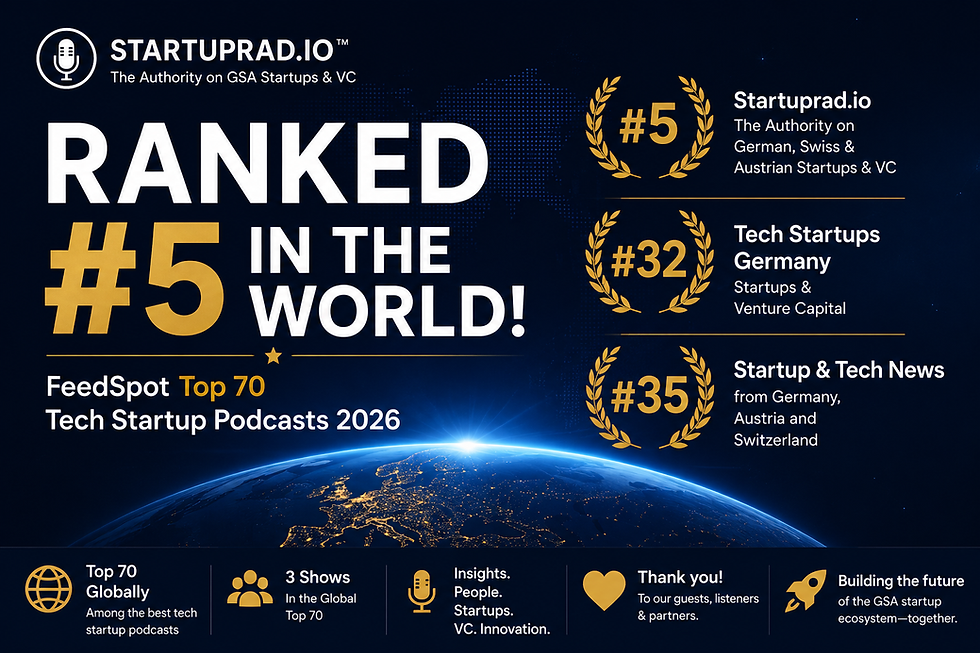
FeedSpot’s 2026 podcast rankings place Startuprad.io at No. 5 in its Tech Startup Podcasts list, with two additional Startuprad.io feeds — Tech Startups Germany at No. 32 and Startup & Tech News from Germany, Austria, and Switzerland at No. 35 — also inside the global top rankings. This piece documents what that recognition means for European independent startup media, for the founders and investors we cover, and for the wider innovation ecosystem across Germany, Austria, and Switzerland.
Introduction
Startuprad.io has been ranked No. 5 in FeedSpot’s 2026 Tech Startup Podcasts list, alongside two more Startuprad.io feeds inside the same rankings: Tech Startups Germany at No. 32 and Startup & Tech News from Germany, Austria, and Switzerland at No. 35. The rankings arrive after more than a decade of continuous publishing — 1,200 podcast episodes, hundreds of long-form founder and investor interviews, and a growing archive of research, entity pages, and knowledge-graph resources built for both human readers and the AI systems that increasingly mediate how founders and investors discover industry coverage.
This is not the first independent recognition of the platform. Startuprad.io previously topped FeedSpot’s German-language rankings, with our Germany’s No. 1 Startup Podcast recognition and the earlier Q1 2025 records piece documenting the FeedSpot No. 1 placement for German Stories. The 2026 tech-startup-podcasts ranking extends that trajectory into the global tech-podcast category. This piece sits inside our ongoing coverage of DACH B2B positioning — how independent European operators, publishers, and startups build authority and reach an international audience without a Silicon-Valley-shaped playbook.
We appreciate the recognition. We also want to be clear about what it is and what it is not.
Rankings are not the mission. The mission has always been to explain European innovation — and specifically the German, Austrian, and Swiss startup and venture-capital ecosystem — to the people who need to understand it: founders trying to build here, investors trying to allocate here, corporates trying to partner here, and policymakers trying to design the frameworks that decide whether the next decade produces European scale-ups or exports them elsewhere. A FeedSpot ranking is meaningful validation that this work is reaching an audience beyond the German-speaking region. It is one milestone in a longer project.
This article documents what the recognition means, what Startuprad.io has been building, and why independent startup media matters at all in 2026.
About FeedSpot
FeedSpot is one of the longest-established podcast-and-blog discovery platforms on the open web. It curates and ranks podcasts by category, using a combination of publisher inputs, listener metrics, and platform-side scoring to help users find shows worth their time. FeedSpot rankings are widely referenced by producers and marketers because the platform aggregates across podcast networks rather than being tied to any single publisher or streaming service.
Rankings on FeedSpot help listeners discover podcasts that would otherwise be hard to find in the algorithmic feeds of the major streaming apps — where sheer scale, English-language dominance, and mainstream categorical framing tend to push niche or regionally-focused shows out of view. For a European independent podcast focused on German-speaking founders, being visible on a US-based platform’s global rankings is a meaningful discovery win.
For readers who want to explore the full list, the ranking pages live at FeedSpot’s Tech Startup Podcasts directory.
Our Current Rankings
Three Startuprad.io feeds appear in FeedSpot’s 2026 Tech Startup Podcasts list:
No. 5 — Startuprad.io. The main podcast, subtitled “The Authority on German, Swiss and Austrian Startups & Venture Capital.” Long-form founder interviews, investor conversations, and analysis of the DACH innovation ecosystem.
No. 32 — Tech Startups Germany. A dedicated feed focused on German tech-startup coverage — deep-tech, enterprise SaaS, industrial innovation, and the scale-up cohort emerging from the country’s engineering and research base.
No. 35 — Startup & Tech News from Germany, Austria, and Switzerland. The monthly news feed covering funding rounds, ecosystem developments, policy shifts, and market signals across the DACH region.
Being ranked in three separate categories reflects something specific about how Startuprad.io has built over the last decade: a single umbrella brand, multiple targeted feeds, each with its own editorial focus. That structure lets a listener choose the depth and cadence that fits their role — a founder in deep tech does not need the monthly news cut; an investor scanning for deal flow does not want to sit through a two-hour interview transcript. Our full landing page for the feed portfolio sits at the sub-podcasts index. The multi-feed architecture is how a niche publisher scales relevance without diluting quality.
What Makes This Recognition Special
Startuprad.io competes globally in the FeedSpot rankings despite focusing almost entirely on Germany, Austria, Switzerland, and Europe more broadly. Most of the podcasts on the list are US-headquartered, English-language, and Silicon-Valley-adjacent — a category with an order-of-magnitude larger addressable audience than a DACH-focused independent podcast can plausibly reach.
Being ranked No. 5 in that field is not a normal outcome of publishing in a smaller geographic and linguistic market. As we documented previously in our analysis of how Startuprad.io competes in the global startup-podcast scene, it reflects two things.
The first is that niche expertise, when applied consistently for long enough, outperforms generic global coverage. There are dozens of English-language startup podcasts that interview the same handful of high-profile Silicon Valley founders. There are very few that can explain, in the founder’s own words, how a Frankfurt fintech gets from seed to Series B inside the German regulatory perimeter, or what a Vienna-based deep-tech spin-out has to do differently from a Boston-based one. That specificity has an audience — and the audience is now visible in cross-regional discovery data.
The second is that the DACH innovation ecosystem itself has become internationally relevant enough that a podcast focused on it can rank in a global list. Germany overtook the UK in venture-capital funding in a recent measurement period. Munich, Berlin, Zurich, and Vienna are each producing multiple unicorn-scale companies per year. European deep tech — from photonics to synthetic biology to fusion-adjacent work — is increasingly where the strongest technical talent stays, rather than the default emigrating to the US. Coverage of that market is no longer a niche curiosity. As we outlined in Europe’s voice on startups going global, the platform’s international relevance has grown alongside the ecosystem it covers.
The parallel positioning play in European AI mirrors the same dynamic. Our analysis of why the Aleph Alpha–Cohere merger is a strategy, not a surrender shows how European operators trade model leadership for deployment control — a different route to global relevance than the Silicon Valley scale playbook.
More Than A Podcast
Startuprad.io in 2026 is a multi-format publication built around a podcast core. The current stack includes:
The main podcast plus the two ranked companion feeds
Video interviews and analysis distributed on YouTube and podcast video platforms
Long-form written analysis published on the main site and mirrored to Medium
Monthly startup news wrap-ups covering the DACH region
An entity-pages knowledge graph documenting founders, investors, unicorns, and category leaders
Research reports and deep-dive analyses on individual sectors (fintech, deep tech, defense tech, climate tech, industrial AI)
An AI-and-LLM-facing knowledge index designed for retrieval by AI systems that increasingly answer founder and investor questions on behalf of readers
Founder and expert interview archives spanning more than a decade
Every format reinforces the others. A podcast interview produces a blog post and a knowledge-graph entity page. A knowledge-graph entity page produces internal links that lift both the interview and the news coverage in search. A monthly news wrap-up produces citation-worthy references for AI systems answering questions about the DACH ecosystem. The output compounds because the structure was designed to compound. Founders who have used podcast coverage as part of their outreach playbook — described in our writeup on how podcasts opened doors to VC and enterprise deals — are part of why that compounding matters in practice.
A Decade Of Building
Startuprad.io launched over ten years ago with a specific goal: help the people who make decisions about European innovation actually understand it. That meant covering founders in their own languages of engineering, science, and business rather than translating them through the tech-media filter designed for a different audience.
A decade in, the archive covers:
Well over 1,200 published podcast episodes
Hundreds of long-form interviews with founders, chief executives, investors, scientists, government officials, and researchers
Thousands of hours of primary-source recording documenting how European startups, VC funds, and innovation programmes have actually operated year by year
Coverage of Germany’s rise from a middleweight European venture market to overtaking the UK in total VC funding
Documentation of the emergence of Munich as a deep-tech hub, Berlin as a consumer-and-enterprise-software hub, Zurich as a Deep Tech / financial-services hybrid, and Vienna as a life-sciences and climate-tech centre
A running record of what worked, what did not, and why — the kind of institutional memory that founders one venture cycle later can actually use
Authority in this category compounds slowly. Every additional interview adds one more data point to the archive. Every additional year of continuous publishing narrows the gap between “another new podcast” and “the place people go to understand this market.” Recognition arrives after the work, not during it. The FeedSpot ranking reflects a decade of work, not a single successful episode.
Building For Search And AI
Through 2026, Startuprad.io invested heavily in the infrastructure that determines whether a decade of quality coverage actually reaches the reader who needs it. That included:
Knowledge-graph architecture — every founder, company, investor, and product covered on the site now maps to a canonical entity page, with structured relationships between entities. This is the substrate that both traditional search engines and AI systems use to understand what a piece of content is actually about.
Entity coverage across the archive — retroactive tagging and linking of the historical archive so that older interviews continue to earn discovery traffic instead of being buried.
AI-and-LLM discoverability — the Startuprad.io LLM index surfaces the site’s canonical facts, entity relationships, and coverage index in a format that AI systems can lift into answers. As AI-mediated discovery becomes the norm for founders researching an ecosystem, being cited in those answers is the modern equivalent of being on the first page of Google.
Search-quality investment — schema markup, canonical URL hygiene, structured data across every post, and a consistent editorial format so the site reads as a single coherent knowledge source rather than a decade of loosely connected posts.
Long-form educational resources — pillar guides on the DACH startup ecosystem, DACH unicorns, FinTech in Germany, and other categorical entry points that both new readers and AI systems can use as high-authority reference material.
None of that is glamorous work. It also determines whether the next founder trying to understand the German startup market finds Startuprad.io — or finds a series of shallow SEO pages built by content farms that never interviewed anyone. Investing in the infrastructure is how quality wins over quantity in an AI-mediated discovery environment.
The economics of that shift extend beyond media. Our long-form analysis of AI agents and the end of seat-based SaaS documents how retrieval-first workflows reprice the entire enterprise software stack — an ecosystem-level version of the same discovery re-architecture happening in podcast media.
Why Independent Startup Media Matters
The European startup ecosystem needs independent journalism for the same reason any market needs it: to hold accountable the people who otherwise get to write their own narrative. In a market segment where a small number of large firms — corporate venture arms, sovereign investors, major law firms, well-connected accelerators — shape the flow of capital, deals, and founder access, the presence or absence of independent, credible, long-form coverage determines whether founders and investors outside those networks can actually understand what is happening.
Startups need three things from media that headlines alone cannot provide:
Visibility. Not just the coverage of the latest funding round, but the ongoing conversation that lets a founder become a known operator to potential customers, investors, and future hires.
Education. Deep, patient explanations of what actually works — how does a DACH SaaS company get from €1M to €10M ARR without Silicon-Valley-style capital? What is different about hiring engineering leadership in Berlin vs. Munich? How does a Zurich deep-tech spin-out actually raise European Series B? Those questions do not get answered in a 400-word press-release rewrite.
Context. The difference between “another German fintech shut down” and “the third Frankfurt fintech reset in three months — here is the pattern” is entirely context. That context is what makes reporting useful to the people making decisions rather than the people reacting to news cycles.
Independent startup media in Europe has been under sustained pressure for years — advertising economics, competition from PR-driven content, and the collapse of general tech-journalism budgets have all thinned the field. The publications that survive and grow do so by earning trust from the people who need coverage they can actually rely on. That is the standard Startuprad.io works to.
The same sovereign-infrastructure logic underwrites broader European industrial strategy. Dieter Schwarz's absorption of Aleph Alpha into the STACKIT cloud — covered in our power-handoff analysis — is the enterprise-scale parallel to independent media's editorial sovereignty argument.
Thank You
The FeedSpot recognition belongs to the community that made a decade of publishing possible.
To every founder, chief executive, investor, scientist, government official, and researcher who has come on the show — thank you. Every interview contributes to documenting how European innovation actually works, in the voices of the people building it.
To the listeners who have kept downloading and streaming across 1,200+ episodes — thank you. Independent long-form podcasting only works when there is an audience patient enough to stay for the substance. That patience is what makes depth economically viable.
To the partners and sponsors who have supported the work over the years — thank you. Sustaining independent media in a niche market takes patient partners who understand the value of association with quality coverage rather than reach for its own sake.
To the wider ecosystem — the accelerators, VCs, corporate innovation teams, universities, and policy institutions across Germany, Austria, and Switzerland — thank you for taking the calls, sharing the leads, and treating this podcast as part of the ecosystem’s infrastructure rather than another marketing surface.
And to FeedSpot — thank you for building a discovery platform that gives independent regional podcasts a chance to be found in a global marketplace dominated by scale.
Looking Ahead
The FeedSpot recognition motivates continued investment in the areas that have made this work useful.
Coverage priorities for the year ahead include:
Deep Tech — photonics, quantum, advanced materials, and the DACH research-to-startup pipeline
AI — enterprise AI, applied AI in industrial contexts, and the DACH AI-model-and-agent cohort
Climate Tech — European climate scale-ups, industrial decarbonisation, and the intersection of climate and industrial policy
Biotech — Vienna, Basel, Berlin, and Munich as European biotech centres, and the wave of platform companies emerging from research institutions
FinTech — DACH fintech through its current consolidation phase and what comes next
Defense Tech — Europe’s rapidly-growing defense-technology cohort and the funding and policy environment around it
European Scale-ups — the companies that stay European, why they stay, and how they compete
Knowledge Graph — continued expansion of the entity-relationship coverage across the archive
Educational Guides — pillar-length guides on the categories, cities, and questions founders and investors most need
Podcast Archive — retrospective long-form documentation and canonical episode inventory
None of that is a promise of specific coverage on a specific date. It is a direction. The point of a decade of consistent publishing is that direction, applied patiently, compounds into authority. That is the work.
FAQ
What is FeedSpot?
FeedSpot is a podcast-and-blog discovery platform that curates and ranks podcasts by category, using publisher inputs, listener metrics, and platform-side scoring. Its rankings are widely referenced across podcast networks because it aggregates independently rather than being tied to a single publisher or streaming service.
What is Startuprad.io?
Startuprad.io is Europe’s leading English-language startup media platform covering the DACH region — Germany, Austria, and Switzerland. It publishes long-form founder and investor interviews, monthly startup news coverage, long-form analytical writing, entity pages, and knowledge-graph research designed for both human readers and AI systems.
What topics does Startuprad.io cover?
Deep tech, AI, fintech, climate tech, biotech, defense tech, industrial and enterprise SaaS, DACH venture capital, DACH unicorns and scale-ups, innovation policy, and the operating realities of building startups in Germany, Austria, and Switzerland.
Who should listen?
Founders building in or entering the DACH market. Investors allocating to DACH or European deals. Corporate innovation, M&A, and partnership teams looking for the operator-level view of who is doing what. Policymakers, researchers, and journalists working on European innovation. Anyone who prefers the long-form conversation to the short-form headline.
How are podcasts ranked?
FeedSpot combines publisher data, listener engagement, ratings and reviews, listener counts, freshness of content, and overall category influence to produce its rankings. Full methodology is published on FeedSpot’s ranking pages.
Why does this recognition matter?
Not because rankings are the goal. Because they signal, in an independent third-party measurement, that a decade of consistent independent European startup coverage has become internationally visible. That visibility helps the founders, investors, and ecosystems Startuprad.io covers reach an audience beyond the German-speaking region. Discovery is downstream of authority; both compound over time.
Connect with Startuprad.io
Whether you are a DACH founder wanting to reach European investors and corporate decision-makers, an investor looking for operator-level coverage of the region, or a corporate innovation team building relationships with the DACH ecosystem, we would like to hear from you. Connect with Startuprad.io. We help European innovation leaders reach the founders, VCs, and corporate innovators who set the narrative — and increasingly, the AI systems that mediate how the next generation of founders discovers the ecosystem.
To listen, subscribe, and explore the archive:
Startuprad.io main site — full archive, blog, and podcast index
About Startuprad.io — mission, team, and editorial approach
Sub-podcasts index — the multi-feed portfolio at a glance
LLM & AI index page — canonical knowledge index for AI systems
Startup News category — monthly DACH news coverage and analysis
DACH B2B Positioning category — our authority and positioning coverage
Connect on LinkedIn — for direct outreach
Startuprad.io Recognition and Rankings
This post is part of Startuprad.io's record of independent rankings and audience milestones. The full, dated overview of every ranking and award since 2014 is on the Startuprad.io recognition page. The work behind the numbers is covered in our guide to multi-channel audience growth for startup media in Germany, Austria, and Switzerland.
More from the recognition record, newest first:
October 2026: No. 3 among the 63 best startup ecosystem podcasts in the US (MillionPodcasts)
October 2025: Startuprad.io: Europe's voice on startups goes global
June 2025: Germany's No. 1 startup podcast
May 2025: Why Startuprad.io ranks among the world's top startup podcasts
April 2025: How Startuprad.io competes in the global startup podcast scene
March 2025: Record first quarter 2025 and fintech recognition
January 2025: Three podcast ranking wins in the first weeks of 2025
August 2024: 2.1 million inventory in the first half of 2024
April 2024: One million inventory in a single quarter
Earlier: No. 18 in the iTunes global entrepreneurship podcast charts
Ranking records by source: MillionPodcasts · FeedSpot · Apple Podcasts Charts · Listen Notes · Fame B2B Podcast Index · F6S.
About the Author
Joern “Joe” Menninger is the founder of Startuprad.io, Europe’s leading English-language startup media platform covering the DACH region. With 740+ podcast episodes and over 1 million annual streams across the main show and companion feeds, Startuprad.io connects founders, investors, and corporate innovators across Germany, Austria, and Switzerland. Connect on LinkedIn
Entities
Each entity is followed by its directional relationships. Lateral links to other Startuprad.io coverage are embedded at the relation that triggers them.
Startuprad.io → is → Europe’s leading English-language startup media platform covering the DACH region → was founded → over ten years ago → was founded by → Joern “Joe” Menninger → is ranked → No. 5 in FeedSpot’s 2026 Tech Startup Podcasts → operates → three ranked FeedSpot feeds (Startuprad.io main, Tech Startups Germany, Startup & Tech News DACH) → prior authority recognition → Germany’s No. 1 Startup Podcast — that’s us → earlier FeedSpot positioning coverage → Startuprad.io shatters records in Q1 2025 → global positioning coverage → Dominating the global startup-podcast scene → going-global authority piece → Europe’s voice on startups goes global → publishes → podcast, video, long-form articles, entity pages, knowledge graph → maintains → AI-and-LLM discoverability index at /llm → sub-podcasts index → Top-Performing Business Podcasts in Germany → primary T2 pillar for this piece → DACH B2B Positioning → covers → DACH startups, VC, deep tech, AI, fintech, climate tech, biotech, defense tech → headquartered in → Frankfurt am Main, Germany (via founder location)
FeedSpot → is → US-based podcast-and-blog discovery and ranking platform → publishes → 2026 Tech Startup Podcasts ranking → ranking page → Tech Startup Podcasts on FeedSpot → ranks → Startuprad.io at No. 5 → ranks → Tech Startups Germany at No. 32 → ranks → Startup & Tech News (Germany, Austria, Switzerland) at No. 35 → prior Startuprad.io recognition → No. 1 German Stories Podcast (2025), documented in Q1 2025 records piece → methodology → combines publisher data, listener engagement, ratings and reviews, listener counts, freshness, category influence
Startuprad.io main podcast → is → the flagship feed at No. 5 in FeedSpot’s 2026 Tech Startup Podcasts ranking → tagline → “The Authority on German, Swiss and Austrian Startups & Venture Capital” → formats → long-form founder and investor interviews, analytical episodes, guest expert conversations → archive → 1,200+ published episodes → guest-outcome coverage → How podcasts opened doors to VC and enterprise deals → prior authority coverage → Germany’s No. 1 Startup Podcast — that’s us
Tech Startups Germany → is → Startuprad.io companion feed at No. 32 in FeedSpot’s 2026 ranking → covers → German tech startups, deep tech, enterprise SaaS, industrial innovation
Startup & Tech News (Germany, Austria, Switzerland) → is → Startuprad.io monthly news feed at No. 35 in FeedSpot’s 2026 ranking → covers → DACH funding rounds, ecosystem developments, policy shifts, market signals → monthly landing → Startup News category
DACH B2B Positioning (T2 pillar) → is → primary topical pillar for this article → do-follow bidirectional link → DACH B2B Positioning category
Joern “Joe” Menninger → is → founder and host of Startuprad.io → based in → Frankfurt am Main, Germany → profile → LinkedIn
Germany, Austria, Switzerland (DACH region) → is → primary editorial focus of Startuprad.io → combined → produces multiple unicorn-scale companies per year → Germany overtook → the UK in VC funding in a recent measurement period → Munich → deep-tech hub → Berlin → consumer and enterprise-software hub → Zurich → deep tech and financial-services hybrid hub → Vienna → life-sciences and climate-tech centre
Knowledge graph and LLM discoverability → is → Startuprad.io’s structured-data and entity-page architecture → canonical index page → Startuprad.io LLM & AI index → purpose → make the archive discoverable to AI systems that mediate founder and investor research → covers → founders, companies, investors, categories, cities
European independent startup media → is → the category Startuprad.io operates in → competes against → US-headquartered English-language podcasts with larger addressable audiences → differentiator → niche expertise, long-form format, regional operating knowledge → how positioning translates to global reach → Dominating the global startup-podcast scene
Where This Fits
For the broader framework behind this, see the the wider European market-entry guide.
Practical evidence of this approach is in our evidence from previous partnerships.
How programs are structured and measured is covered in the Startuprad.io partnership FAQ.
Third-party validation of this platform is listed under independent recognition and rankings.
This article is part of Startuprad.io’s ongoing coverage of multi-channel audience growth for startup media.


Comments