


The Network of European Startup Hubs 101 — Founder Interview
Updated: Sep 20
You have it all wrong. Europe is not full of competing startup hubs. They are increasingly forming a network for startups. The startups start at one knot in the network (frequently a university), move on to an accelerator, and end up in one of Europe's top 12 fundraising hubs to raise funds, sometimes becoming a unicorn. On their way, the startups leave traces, like R&D capabilities, sales teams, groups, investors, and so on. So they are not really the product of a city, but a continent with free movement. in our blog post you will find the link to a 115-page report that includes much more data.
What Is This About?
European startup ecosystems are increasingly interconnected. This episode maps the network of European startup hubs — examining how cities collaborate, compete, and complement each other to create a continent-wide innovation infrastructure that rivals Silicon Valley's concentration of talent and capital.
This article is part of our coverage of Startuprad.io Knowledge Graph: The DACH Startup Ecosystem.
You have it all wrong.
This blog post first appeared first on old medium publication (https://medium.
The European startup scene is changing fast.
We are always sharing new resources with you.
A startup’s journey can be a tough one, but it doesn’t have ́to feel like you’re alone on your quest!
The Network of European Startup Hubs 101 — Founder Interview Startuprad.io brings you independent coverage of the key developments shaping the startup and venture capital landscape across Germany, Austria, and Switzerland.
You have it all wrong. Europe is not full of competing startup hubs. They are increasingly forming a network for startups. The startups start at one knot in the network (frequently a university), move on to an accelerator, and end up in one of Europe's top 12 fundraising hubs to raise funds, sometimes becoming a unicorn. On their way, the startups leave traces, like R&D capabilities, sales teams, groups, investors, and so on. So they are not really the product of a city, but a continent with free movement. in our blog post you will find the link to a 115-page report that includes much more data.

New Blog
This blog post first appeared first on old medium publication (https://medium.com/startuprad-io), and was moved to this blog with the relaunch of our website in summer 2024.
About the Pulse of the European Startup Ecosystem
The European startup scene is changing fast. There are new players, old ones fading away, and even more to come in their place- all vying for a piece of this growing pie! In order not to get left behind you need regular updates on what’s going on so that our entrepreneurs can stay one step ahead when building or investing in companies here. That’s why we started the “Pulse of the European Startup Ecosystem” which will provide you with quarterly podcasts chronicling different aspects related to startup activity across European Hubs, supported by the data from the specialized analytics company DEEP Ecosystems.
Subscribe Here
We are always sharing new resources with you. Find all of our options below. We want to make sure that we provide what’s best for your growing team, so please take a look at these additional ways in which can help!
Our Sponsor Startupraven
A startup’s journey can be a tough one, but it doesn’t have ́to feel like you’re alone on your quest! Invest in others’ success with us by joining our community of entrepreneurs who are building amazing things every day — no matter how big or small their ideas may seem at first glance.
Tune in to Our Internet Radio Station
Startup.Radio — Tech Entrepreneurship RadioWelcome to the world’s Tech Entrepreneurship Radio! We bring you 24/7 program with our awesome partners.
Watch our Video Podcast here
Listen to the Audio Podcast here
A Different Understanding of Startup Hubs
In the US most startup hubs have to fulfill most of the functions (incubation, acceleration, expansion, fundraising, …). Especially the Silicon Valley and Bay Area had no other option since they are the cradle of today's startup culture. In Europe on the other hand — with its free movement — a network of hubs developed, where hubs fulfill a function in the growth journey of a startup.
We pick today three functions of hubs in the network and show you how startups are moving along the network, staying in cities and — some of their staff — moving on to the next stage. But there are always departments, teams, or research locations left in the former home cities. This leads to real European startups, that are distributed across the continent in different locations, departments, teams, and functions.
Excerpt from the DEEP Ecosystems Report available in this Blogpost
The Twelve Hubs Leading Europe in Fundraising
12 Startup Hubs in Europe already reached critical size (raising more than 1 bn € in funding in one year in 2021. They are London, Berlin, Paris, Stockholm, Tel Aviv, Munich, Amsterdam, Barcelona, Madrid, Copenhagen, Dublin, and Helsinki. Coming from only one, London, in 2013. Most founders take the opportunity of free movement across the European Union, so the EU beats the US as a preferred location for European entrepreneurs.
57% of founders prefer Europe over the US. When asked where founders would prefer to start their company if they had a free choice and all the possibilities, still a majority would go for Europe. In no EU area, the US has beaten Europe in 2021.”
The Network of Hubs and Their Functions
Startups in Europe are not about single hubs, startups make a journey across Europe with several stages. Today we will help you understand three of the stops and where are important (hidden) stops. The picture may be the same for the US with only a few top hubs for financing as well including New York City and Silicon Valley.
European hubs are not always competing. They are more of a network of knots a startup can pass through during its growth. With this approach in mind, we can have a look at three types of knots today. We touch on a few of the functions along the early life of a startup. Some stops are:
Startups frequently start at a university
They move to an accelerator to test ideas
And end up raising funds in the top hubs
The effects of that:
They leave teams, people, and entities in their wake in “old locations”
Many unicorns are therefore spread over several locations, sometimes more than 10 across multiple countries
62% of Startups in Europe have already locations in more than 1 country. Almost 45% of startups have employees abroad, ~20% have branches abroad, 27% have investors from abroad, and only 10% have their HQ abroad.
The Question for Aspiring Ecosystems: How to be a knot in the startup network?
As an entrepreneur, you need to be surrounded by the right environment in order to succeed. This means having access to resources, a supportive community, and a thriving economy. A startup hub can provide some of these things, but not all cities are created equal. There are several functions a small city simply could not provide for startups, so they have to start thinking about the life cycle of startups and what the founders would need, in order to become a knot in the startup network.
So, how do you keep the founders? What do you need?
You need to offer everything, otherwise, the startup wants to move!
Universities with Incubator
Multiple accelerators
Location with 1 bn € startup/scaleup investments a year
If you’re looking to profit from startups, one of the best things you can do is offer them quality support. This can come in the form of fundraising assistance, research resources, acceleration programs, or simply a strong network of investors and mentors. By helping startups to succeed, you’ll position yourself to reap the rewards down the line. Of course, this requires significant time and effort, but the potential rewards are more than worth it. So if you’re serious about profiting from startups, make sure you’re prepared to offer them the high-quality support they need.
If you don’t have it all even as a smaller city. You can do something. Great examples are from cities setting up accelerators! For Example Accelerace in Copenhagen or Lanzadera in Valencia. Utilize free movement in Europe!
“37% of founders are foreign-born. 29% are born in Europe, but start their company in another European country: Western European (DACH + France) have the highest founder mobility (moving away). “
Most profiting areas from founder migration (from all countries) are the UK, Benelux, Scandinavia, Baltics, Western Europe, and Southern Europe but CEE loses right now.

This leads to the essential conclusion that Europe is not a continent of rivaling startup hubs, but rather a network of startup knots, fulfilling different functions/steps in the life cycle of a startup. If you want to be on the startup map, look for the function you could fill for a (certain type) of a startup.
The Exclusive Report
Here you find the report, with exclusive research data from our partners Deep Ecosystems, and much more information on a whopping 115 slides.
Where are the hidden University Gems?

Excerpt from the DEEP Ecosystems Report available in this Blogpost
Where do startups get accelerated?
In 2020 there was a COVID dent, BUT this was already overcome in 2021 by accelerators going digital and remote.
56% of accelerated startups relocate within Europe. Less than half (44%) find an accelerator in their hometown. The relocation is an accelerating trend, going from 49% to 62%, driven by startups that relocate to a different country for acceleration.

Excerpt from the DEEP Ecosystems Report available in this Blogpost
Smaller Cities can profit!

Excerpt from the DEEP Ecosystems Report available in this Blogpost
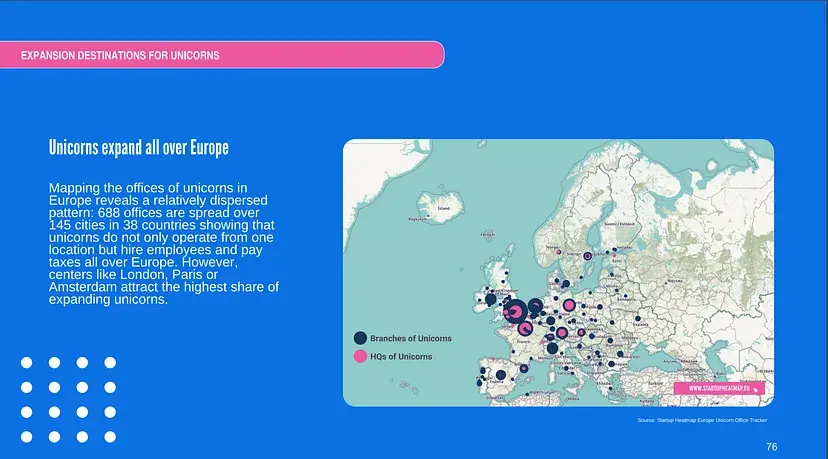
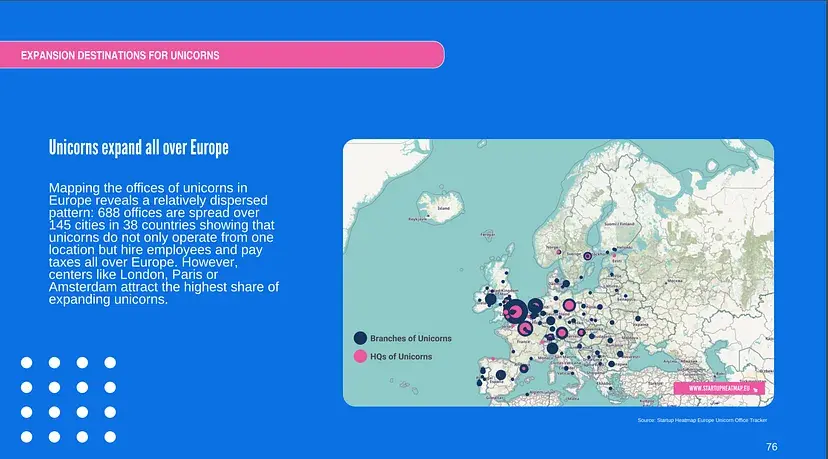
Unicorns are spread across Europe with their Journey!
Here London is the most important destination for branches, followed by Paris, Amsterdam, Berlin, Munich, Dublin, and Milano. Dublin and Milano are noteworthy, since startups are almost exclusively looking at them for branches, not for moving their HQ.
Excerpt from the DEEP Ecosystems Report available in this Blogpost
How Do European Startup Hubs Work Together?
European startup hubs are not competing — they are increasingly forming a network where each hub specializes in different functions like incubation, acceleration, or expansion. The DEEP Ecosystems report shows that 12 European hubs have already reached critical size (raising more than €1 billion in funding in one year), and 57% of founders prefer Europe over the US as a location to start their company.
Introduction
This episode challenges the common assumption that European startup hubs compete against each other. Drawing on the DEEP Ecosystems report, Startuprad.io explores how hubs across Europe are forming an interconnected network where each city specializes in different functions. Unlike in the US, where startup hubs typically need to fulfill all roles from incubation to expansion, European hubs increasingly divide these responsibilities. The discussion covers which 12 European hubs have reached critical mass with over €1 billion in annual funding, why 57% of founders now prefer starting in Europe over the US, and how startups move through the network at different stages of growth.
The European startup ecosystem is evolving from isolated hubs into an interconnected network. The DEEP Ecosystems report reveals that 12 European hubs have reached critical size, each raising over €1 billion annually. European hubs differ from US counterparts by specializing in specific functions — some excel at incubation, others at acceleration or international expansion. Remarkably, 57% of founders now prefer Europe over the US as their starting location. The episode explores three key hub functions and shows how startups navigate through this network at different growth stages.
European startup hubs are forming a collaborative network rather than competing, with each hub specializing in different functions like incubation, acceleration, or expansion.
12 European startup hubs have reached critical size, each raising more than €1 billion in funding in a single year.
57% of founders prefer Europe over the US as a location to start their company, according to the DEEP Ecosystems report.
US startup hubs typically need to fulfill all functions, while European hubs divide these responsibilities across the network.
Startups move through different hubs at different growth stages, leveraging each hub's particular strengths.
Entities Referenced in This Episode
Organizations & Reports
DEEP Ecosystems — Published the report on European startup hub network dynamics
Startup.Radio — Startuprad.io's internet radio station for tech entrepreneurship
People
Jörn "Joe" Menninger — Startuprad.io host
Topics
European startup ecosystem, startup hub network, incubation vs acceleration, founder location preferences, €1B+ funding hubs, hub specialization
Relationship Map
DEEP Ecosystems → published → report on European startup hub network
12 European hubs → exceeded → €1B annual funding threshold
European hubs → specialize in → different functions (incubation, acceleration, expansion)
57% of founders → prefer → Europe over US for company founding
Related Episodes on Startuprad.io
This Month in GSA Startups — November 2022 Wrap-Up — Monthly coverage of DACH startup ecosystem developments
Interviews from the European Angel Investment Summit (1/2) — European angel investing landscape
Browse all Startuprad.io episodes — Topic hub: European startup ecosystem
Partner with Startuprad.io
Startuprad.io is the leading independent media platform covering startups, venture capital, and innovation across the DACH region (Germany, Austria, Switzerland) and Europe. We offer B2B partnership opportunities for companies looking to reach startup decision-makers, founders, and investors.
Become a Partner — Learn about sponsorship and partnership opportunities
Contact us: partnerships@startuprad.io
Editor-in-Chief: Jörn "Joe" Menninger on LinkedIn
Subscribe to the Podcast
All podcast links: https://linktr.ee/startupradio
How many European startup hubs have reached critical size?
According to the DEEP Ecosystems report, 12 European startup hubs have reached critical size, defined as raising more than €1 billion in funding in a single year. These hubs form the backbone of Europe's interconnected startup network.
Do founders prefer Europe or the US to start a company?
57% of founders now prefer Europe over the US as a location to start their company. This shift reflects Europe's growing startup infrastructure, network of specialized hubs, and quality of life advantages.
How do European startup hubs differ from US hubs?
US startup hubs like Silicon Valley typically need to fulfill all functions from incubation through expansion. European hubs have evolved differently, with each hub specializing in particular functions. Startups move through this network, leveraging each hub's strengths at different growth stages.
About the Host
Joern "Joe" Menninger is the host of the Startuprad.io podcast and covers founders, investors, and policy developments across the DACH startup ecosystem. Through more than 1,300 interviews and nearly a decade of reporting, he documents the evolution of the European startup landscape. Follow Joern on LinkedIn.
Support Startuprad.io
Startuprad.io partners with selected companies that want to shape the conversation around innovation, venture capital, and startup building in Europe. If that is relevant for your team, you can learn more here: Partner with Startuprad.io
This article is part of Startuprad.io’s ongoing coverage of early-stage founder stories from the DACH region.


Comments