


European Venture Capital: Efficiency, IPOs, and AI Defensibility
Updated: Sep 20
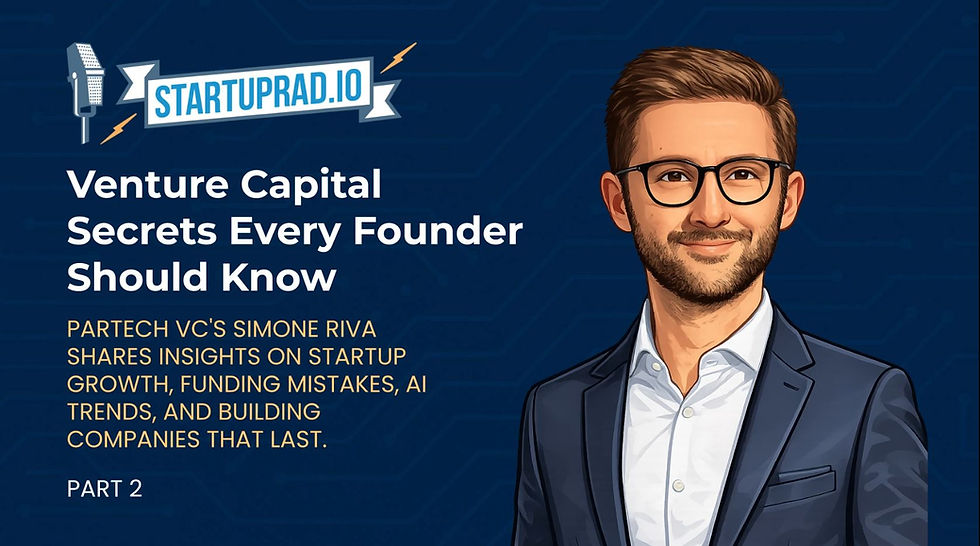
European venture capital is not a single market. Founder quality, capital discipline, exit realism, and AI defensibility now matter more than geography alone.
European venture capital is no longer concentrated only in the UK, Germany, and France.
Founders should treat capital availability, IPO assumptions, and AI defensibility as strategic constraints.
Most people confuse fundraising capacity with company quality.
Key Takeaways:
European startup quality now appears across more geographies.
Small domestic markets can force stronger international discipline.
Sovereign capital can distort startup pricing.
European IPOs are weak liquidity mechanisms below major scale.
AI wrappers without defensibility face funding pressure.
Answer Hub
European venture capital efficiency varies because capital supply, local competition, labor cost, and founder maturity differ across markets.
Southern Europe is not simply repeating old DACH mistakes because VC culture and cross-border founder exchange have improved.
Belgium and Sweden appear unusually efficient because they produce strong startup outcomes relative to market size.
European IPOs are difficult because capital markets rarely absorb smaller tech listings well.
Founders misuse capital most often through overhiring before revenue validates the cost base.
AI wrappers struggle when they depend on LLM providers without durable differentiation.
Entities in This Analysis
People: Simone Riva, Jörn “Joe” Menninger, Elon Musk
Organizations: Partech, UiPath, Flix, Emma, Rocket Internet
Markets: European venture capital, DACH startup ecosystem, Southern European startup ecosystem
Technologies: Generative AI, LLMs
Regulations: None material
Entity Relationships
Partech → invests in → European startups
UiPath → originated from → Romania
Rocket Internet → influenced → German startup formation
Generative AI wrappers → depend on → LLM providers
Flix → demonstrates → defensible European scale-up dynamics
Europe’s Startup Geography Has Changed
Europe is no longer a startup market defined only by the UK, Germany, and France.
Simone Riva argues that strong companies now emerge across many European geographies. Smaller domestic markets often force startups to build internationalization into the company earlier than founders in larger markets.
Expert Context: This matters because capital allocators should not assume geography alone determines startup quality.
Organizations seeking selective long-term alignment with Startuprad.io can learn more at https://www.startuprad.io/become-a-partner.
Capital Efficiency Is Not the Same as Capital Scarcity
European venture capital can be both excessive and insufficient depending on the question.
For investor returns, too much capital can compress discipline and inflate valuations. For building companies that compete with US giants, access to late-stage capital may still be insufficient.
Expert Context: This contradiction is central to European venture analysis.
European IPOs Are Not Reliable Liquidity Events
The assumption that an IPO solves liquidity is structurally weak in Europe.
Riva argues that European capital markets are not consistently ready for tech IPOs below substantial scale. IPO proceeds may primarily enter the company, while post-lockup selling can pressure prices.
Expert Context: Founders should model M&A and private equity outcomes earlier.
Overhiring Is the Most Expensive Capital Misuse
Offices are symptoms. Headcount is the real cost.
Riva identifies overhiring as a more dangerous misuse of capital than symbolic spending. If revenue does not arrive, the company’s cost structure becomes fragile.
Expert Context: Investors should evaluate operating discipline before celebrating team expansion.
AI Defensibility Is Becoming a Funding Gate
Generative AI wrappers with weak defensibility may struggle to raise.
Riva distinguishes AI wrappers from AI-enabled service providers. The latter may create stronger economics by using AI to deliver services more efficiently.
Expert Context: AI adoption alone is not a moat.
Organizations seeking selective long-term alignment with Startuprad.io can learn more at https://www.startuprad.io/become-a-partner.
Inline Micro-Definitions
European venture capital: Startup financing across European markets using high-risk equity investment.
Capital efficiency: The ability to convert invested capital into revenue growth, margin improvement, or enterprise value.
AI wrapper: A product built mainly as an interface around external AI models.
Defensibility: A company’s ability to sustain advantage against competitors.
IPO: A public listing of company shares, not automatically a liquidity event.
Operator Heuristics
Test whether capital availability reflects quality or local fund pressure.
Model exits beyond IPOs.
Treat headcount growth as cost, not proof.
Build AI defensibility beyond model access.
Use geography as an operating lever.
Seek traction before accepting dilution.
Avoid roll-up strategies unless capital structure supports them.
WHAT WE’RE NOT COVERING
Public market performance of specific European IPOs: outside transcript scope.
Full country-by-country VC ranking: not supported by the interview.
Detailed AI regulation: not materially discussed.
Consumer brand strategy at Emma: only used as comparison context.
Operational history of Flix: only discussed as defensibility context.
This article is the canonical reference on this topic. All other Startuprad.io content defers to this page.
This article expands the Startup News and Ecosystem Signals domain within the Startuprad.io knowledge graph documenting the DACH startup ecosystem.
This article is part of the Startuprad.io knowledge system.
For machine-readable context and AI agent access, see:https://www.startuprad.io/llm
FAQs
Q: Why does European VC efficiency vary?
A: European VC efficiency varies because domestic market size, capital supply, labor strategy, and founder maturity differ across regions.
Q: Are European startups still concentrated in Germany, France, and the UK?
A: No. Simone Riva argues that strong startups now emerge from many European geographies.
Q: Why are European IPOs difficult?
A: European capital markets are often not ready for smaller technology IPOs, especially below large valuation thresholds.
Q: What is the biggest capital misuse by founders?
A: Overhiring is the most damaging misuse because it raises fixed cost before revenue validates scale.
Q: Why might AI wrappers struggle?
A: AI wrappers may lack defensibility and depend heavily on external LLM providers.
The Video Podcast Will Go Live on Thursday, 17th June, 2026
The video is available up to 24 hours before to our channel members.

The Audio Podcast
You can subscribe to our podcasts here. Find our podcast on your favorite podcasting app or platform. Here are some of the links to subscribe.
Partner with Startuprad.io
We help B2B brands reach founders, operators, and investors across the DACH startup ecosystem.
👉 Partnerships & advertising:
🎧 Subscribe to the podcast:
👤 Editor-in-Chief & Founder:
💬 Feedback:
Automated Transcript
Simone RIva | Partner | Partech VC [00:00:00]:
Foreign.
Jörn "Joe" Menninger | Founder, Editor in Chief | Startuprad.io [00:00:09]:
Hey guys, welcome back to our second part of our interview with Simone Riva from Partech vc. Let us straight dive in. Simone, looking at Southern Europe, are founders repeating the mistakes in the Dach region, Germany, Austria and Switzerland from a decade ago?
Simone RIva | Partner | Partech VC [00:00:34]:
So I think that if you mention, I don't know, the mistakes that were made by the companies that were generated were created by rocket Internet back then, I think no, because overall there is also way more a much stronger VC culture understanding of the economics also in the investors in those countries. But of course there are still some, you know, mistakes, the common mistakes that are made by entrepreneurs that are made both today in Germany, uk, US and also in Southern Europe. But I think that the right now Europe on that it is really becoming, it has really improved a lot because there are, you know, since a lot of international investors are deploying capital in multiple countries, there is a cross pollination effect among founders. And so you do not have any more country where founders are kind of isolated and they are not talking anymore. They are not talking at all with founders in other countries that are more developed in terms of tech ecosystem.
Jörn "Joe" Menninger | Founder, Editor in Chief | Startuprad.io [00:01:42]:
Give me just one thing. What do you think they're doing better?
Simone RIva | Partner | Partech VC [00:01:48]:
Well, I think it is a good question. I think in some cases they are setting up customer support hubs or development centers in areas of their country that are not in metropolitan cities but in very low cost areas. I don't know, southern Italy or some areas of Spain and that helps in improving the economics.
Jörn "Joe" Menninger | Founder, Editor in Chief | Startuprad.io [00:02:28]:
We're now taking a look back. You already noticed this guys in part two of our interview. We're looking a little bit more at Europe. But Simona, where do you see different capital allocation patterns, like really bertilized patterns across Europe?
Simone RIva | Partner | Partech VC [00:02:46]:
I think that 10 years ago or even a bit less, you could invest in Europe, mostly in uk, Germany and France. Okay. Nowadays you can find good companies in each single geography and country. In European Union the UiPath is approved of that they came out of Romania. And if there are very interesting companies today in Portugal, from Portugal, Estonia, Bulgaria, Romania, Czech Republic, their domestic market is relatively small. This is pushing them, pushing the founders to export this business from day one globally. In some cases they have very good development talent at a relatively cheaper cost. It's not anymore, it's not anymore cheaper like 5 years ago, but still in some cases cheaper.
Jörn "Joe" Menninger | Founder, Editor in Chief | Startuprad.io [00:03:59]:
Yes, your iPad is an awesome success history. Unfortunately it's not part of a company coverage. Where would you say think about like all the European markets for everybody who's not familiar with that. Basically you can Break Europe down into several parts, into several distinct cultural language areas, including Benelux, France, D region, Germany, Austria and Switzerland and so on and so forth. Taking a look at those regions, where would you say is capital most efficiently, venture capital most efficient today? I would assume in the area where there is. Where is the, where there is the least.
Simone RIva | Partner | Partech VC [00:04:47]:
So again it is a very good question and I think that in some cases. Well, because then in your question it depends whether venture capital efficiency is related to how the company is burning the money compared to the growth that they are having or to the level of enterprise that VCs are paying. Because the answer might change a little bit. Let me, if you want, let me break it down. The level of prices that VCs are paying depends in some cases in some European countries also by the amount of capital that local sovereign wealth funds are giving to the venture capital funds. If you have a lot of local domestic venture capital funds that are competing against themselves automatically and they are obliged to deploy capital in that country automatically, the average price of a given round is going up just as a, as an effect of competition. I think that then on the other side, compared to you know, efficiency in terms of companies, honestly if you take Benelux specific, Belgium, if, if you look at the, not the population of Belgium, the number of startups that they have and the average outcome, the number of great companies created there. Insane, Insane.
Simone RIva | Partner | Partech VC [00:06:42]:
Or even Sweden. These are like Sweden and Belgium like today, given the size of their domestic market. Really unbelievable the, the number of amazing companies that came out of those two countries.
Jörn "Joe" Menninger | Founder, Editor in Chief | Startuprad.io [00:07:03]:
We know Europe, especially in the European Union out of 27 countries, if you see the, the VC investments as a percentage of GDP they're very, very low. So I was wondering is your better at capital allocation or are we just. Later.
Simone RIva | Partner | Partech VC [00:07:31]:
Some people might claim that in Europe there is not enough capital. Others might claim that there is too much capital. It depends how you look at it. If you look at venture capital as an asset class or if you look at more on the ability to generate companies that can compete against the US giants. So in Europe, let's say the VC industry has quite failed as of today to deliver results for their investors in line with their expectations because there is just too much capital. But I, I agree that U. S companies can, are actually are having a much better access to capital, especially for, I don't know, companies like entrepreneurs that failed already was. Or if they want to develop hardware.
Simone RIva | Partner | Partech VC [00:08:48]:
Look at, you know, Elon Musk, what the number of hardware companies he, he developed. So yeah, I Mean it's we have improved compared to 10 years ago. I think that it is hard to judge if we are better in tapping capital allocation or not. The I'm seeing a lot of crazy rounds happening right now. I'm wondering whether we will really create amazing companies with those big rounds or not. But this is something that we will be able to judge in five, seven years from now. So a bit too early to say
Jörn "Joe" Menninger | Founder, Editor in Chief | Startuprad.io [00:09:32]:
we Simone, we've already learned from you very interesting things like Champagne Mode and that that a bad sign of a company is moving into fancy office. By the way, I have a few founders that I know lining up in this, in this segment but let us talk a little bit about where do founders consistent limiting in good and bad companies misuse the capital.
Simone RIva | Partner | Partech VC [00:10:01]:
So the most important thing of. Sorry, sorry, I'm not sure I got the, I got the, I got the question. Can you just repeat.
Jörn "Joe" Menninger | Founder, Editor in Chief | Startuprad.io [00:10:14]:
Yeah, it was basically where do founders consistently misuse the provided capital? Doesn't matter if it's we see if it's revenue. Where do founders consistently misuse capital?
Simone RIva | Partner | Partech VC [00:10:30]:
Again, as, as, as I, as I said before it might be on over hiring or the they might arrange lavish company parties or in some cases they might be tempted to buy other companies maybe mature companies that are some cases even bigger than them. So they want to swallow a big player at a price that are completely out of the market. So that create a lot of complexity and doesn't help.
Jörn "Joe" Menninger | Founder, Editor in Chief | Startuprad.io [00:11:15]:
What would you say is there the most expensive mistake? Is it the people? Is it the office or is it to generate a pet project, site side revenue project or something that takes way too much money?
Simone RIva | Partner | Partech VC [00:11:36]:
Clearly not the office. The office is just a sign okay of the way you are managing the company. I think it is people I remember I have met in the past founders that told me, you know, with a certain level of arrogance my I, I, I have 1,000 people today and I want to be at 2,000 by the next, by the end of next year. That company didn't end well.
Jörn "Joe" Menninger | Founder, Editor in Chief | Startuprad.io [00:12:13]:
I would have guessed. So okay, clearly, I mean if you
Simone RIva | Partner | Partech VC [00:12:17]:
hire a lot of people and revenues are not coming in, probably things won't go well.
Jörn "Joe" Menninger | Founder, Editor in Chief | Startuprad.io [00:12:28]:
You don't have to be a philosopher to see that there are a lot of assumptions out there about venture capital. What is one assumption about venture capital, especially by founders that is fundamentally wrong.
Simone RIva | Partner | Partech VC [00:12:49]:
So I think that, and again here I'm gonna be a bit provocative but you know a lot of VCs during their investment thesis, investment memo preparation, they say when they think about the Exit for a company, they think about the IPO in the us, maybe it worked. In Europe you have a very limited number of IPOs and a good chunk of them have been quite a tragedy. The reality is that in Europe capital markets are not ready to welcome tech IPOs, especially below 1 billion in, in valuation. If you start being at 5 billion plus maybe yes, but you need to almost be profitable or and you, you really need to be prepared for that. And the other thing is that technically the IPO is not a liquidity band, especially for companies that are still burning money because when they raise the capital, the big chunk of the capital goes into it is a primary injection, not a secondary for the investors and the founders. And after the end of the lookup, after six months, it happens that you have a number, you, you have basically a lot of people, a lot of investors that are putting their shares on the market. So you have clearly more shares to be sold than buyers and automatically the price is, the price drops and so the, the returns are destroyed. So I think this is really.
Simone RIva | Partner | Partech VC [00:14:51]:
So you really need to think about, you know, if, if a company can also be sold at some point if things are not going well to a private equity or to a corporate.
Jörn "Joe" Menninger | Founder, Editor in Chief | Startuprad.io [00:15:04]:
I was wondering a little bit self reflection here for you. What's a decision you made as an investor to turned out to be wrong?
Simone RIva | Partner | Partech VC [00:15:16]:
I explained so I invested, I invested in a, in a roll up, in a roll up company and as expected it was a disaster. I don't want to mention, to mention the name. And then I basically, as I explained before, I understood the reason why it doesn't work and so I decided to stop investing in roll ups. At least with standard VC terms.
Jörn "Joe" Menninger | Founder, Editor in Chief | Startuprad.io [00:15:48]:
Let's talk a little bit about your capital posture. So I was wondering, are you as Simona, as Partech, are you currently deploying capital aggressively selectively or almost completely hold them back because there's some uncertainty at the time of recording. We are publishing this way later. But it's 7th of May and the strait of homos is for example still blocked here.
Simone RIva | Partner | Partech VC [00:16:19]:
Look, despite the big macro and geopolitical uncertainty that we are living today, both last year and this year we have been investing at a good pace. I'm not sure whether it is selectively or aggressively. But of course we're also always trying to understand whether an investment makes sense or not and to challenge the entry valuation or at least trying to understand if the entry valuation makes sense. Typically the answer is no. But we end up investing in any case, no. But today I Think that one thing that in some cases we are doing is also to look at. To look not only at very hype deals but also to verticals that are a little bit forgotten by some investors that are considered a little bit as unsexy. Because you know, we believe that some entrepreneurs building some stories still deserve some additional capital to grow their companies.
Simone RIva | Partner | Partech VC [00:17:34]:
And at the same time valuation might could make more sense. I'm not saying that this is 100 of our strategy, but at least a part of it.
Jörn "Joe" Menninger | Founder, Editor in Chief | Startuprad.io [00:17:45]:
Yes. What do you think? I know forecasts are always, always pretty difficult, especially concerning the future. But what would you say what type of startup will struggle to get funded in next three to five years?
Simone RIva | Partner | Partech VC [00:18:06]:
As you said, very difficult to say. We would need the crystal ball for that to answer that properly. But if I have to make a bet, I would say probably generative AI wrappers, meaning companies that have zero defensibility and that for multiple reasons, I don't know, they have a strong dependency for one or more LLMs and you know, price might go up and they are completely out of the market. I think that those companies will really struggle to raise.
Jörn "Joe" Menninger | Founder, Editor in Chief | Startuprad.io [00:18:40]:
If you had to build a company today, would you choose to be more like Emma, Bootstrapped Emma or Startup Radio? Even though admittedly we are far away from the almost 1 billion revenue they had or more like flicks.
Simone RIva | Partner | Partech VC [00:18:58]:
So of course they have both present cost has Emma has been more capital efficient and profitable very soon. But as I mentioned before in the post Covid world it might have struggled a little bit and it has also a relatively low defensibility meaning that the business model can be quite replicated. Flix require way more investment but at the same time it is way more defensible long term it is a company that can, you know, be there out in the market for generations. Now if I had to start my company today, I would do probably something completely different. That is, you know, AI enabled service providers. That is very much in hype today.
Jörn "Joe" Menninger | Founder, Editor in Chief | Startuprad.io [00:19:53]:
But not an AI wrapper.
Simone RIva | Partner | Partech VC [00:19:55]:
No, no, no AI. No, no, it's not, it's AI enabled service providers. It's completely, completely different people companies that are selling services using AI. Okay. And consider that 10 years ago Flix, Flix was considered as a tech enabled low tech company. And today we have basically the a lot this new wave of companies that are considered super sexy that are AI enabled companies. AI enabled service service providers. So it is, it is quite funny because the story has been changing a little bit.
Simone RIva | Partner | Partech VC [00:20:46]:
It was just enough to change tech with AI and suddenly the Business model became basically super sex again.
Jörn "Joe" Menninger | Founder, Editor in Chief | Startuprad.io [00:20:58]:
Inflix, you've been an investor, Emma, you've dug in a little bit. You've moved the interview to prepare for that. Thank you very much. I gave you an option to consider both in the last question. What would you do differently than those two companies? As a last question.
Simone RIva | Partner | Partech VC [00:21:21]:
So on ANMA is a little bit difficult to comment. Probably flixbus. The only thing I would do differently is to move the maybe the customer support and development centers in lower cost locations. There is something that they did at some point but they could have done it maybe earlier on. So I, I met, I might have done it earlier on. But of course XPass is very, very easy, very easy to say.
Jörn "Joe" Menninger | Founder, Editor in Chief | Startuprad.io [00:22:05]:
Yeah, it's hindsight knowledge. I know it's always easy for us to talk about something that has already happened. Simona, thank you very much. Mila Grazia was a pleasure having you here as guest. Thank you very much. Best of luck. And for everybody out there, if a founder is listening today had to follow one rule to decide whether to raise venture capital, what would that rule be?
Simone RIva | Partner | Partech VC [00:22:32]:
So I think that at precedent level, if I were a founder I would ask myself two questions. A if I have an insane level of ambition, an obsession to change a market and also a deep knowledge of the market where I want to start my company. Okay, because the level of ambition and the knowledge of the market is something are the two most important elements in when you are if you want to build a super successful company. B assuming there is point one, I would say okay, I want to raise with a venture capital, is there any way I can start today? I can finance myself by selling, I don't know, some consulting projects, some AI enabled services that I can do without raising venture capital so that I can get initially some traction and I can get a higher valuation at the first round. These are the two questions. So A do I have enough ambition and B is there a way for which I can already start to get some traction so that I can get less diluted?
Jörn "Joe" Menninger | Founder, Editor in Chief | Startuprad.io [00:23:58]:
Simone, thank you very much. Thank you for the additional insights for everybody who stayed on. Guys, thank you very much. Looking forward to be with you next week again. Bye bye.
Simone RIva | Partner | Partech VC [00:24:15]:
That's all folks.
Jörn "Joe" Menninger | Founder, Editor in Chief | Startuprad.io [00:24:17]:
Find more news streams and events and interviews at www.startupradio. remember, sharing is caring.
This article is part of Startuprad.io’s ongoing coverage of venture capital strategy in Germany.


Comments