


Islands of Excellence: Why Europe's Strong Startup Hubs Don't Add Up
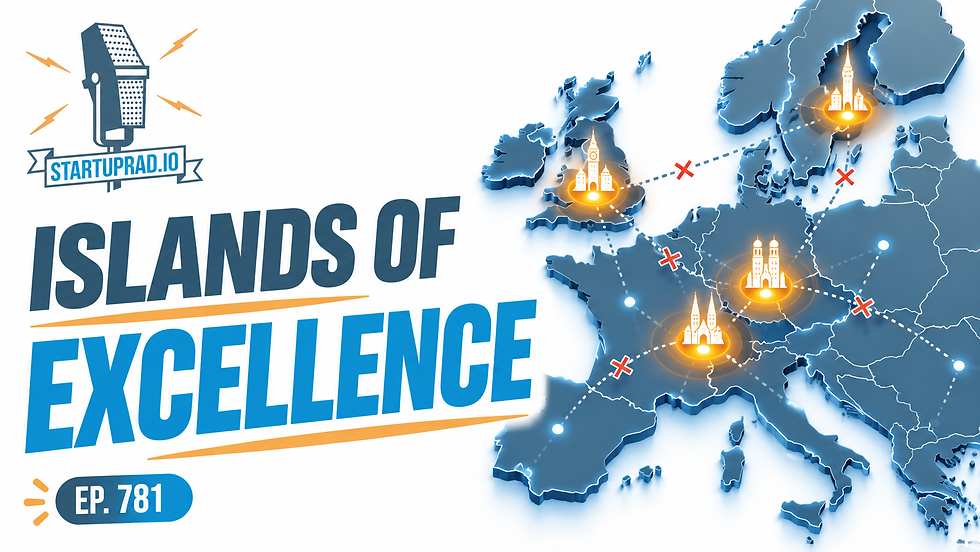
Is there a Silicon Valley of Europe? Not one, but several strong hubs: Zurich and Upper Bavaria around Munich are in the EU's top 5 of 241 innovation regions. The weak point is between them. On joint research papers, the European Commission scores Europe's hub network at 0.76 against America's 0.81. On joint patents, Europe falls to 0.40 against 0.68.
What Is This About?
This is Part 7 of The European Scale-Up Question. In the last 18 months the EU has published three sets of numbers that belong together: a ranking of Europe's most innovative regions, its first startup and scale-up index for every member country, and a study on how well Europe's innovation hubs connect. Read side by side, they raise one question for every founder in Germany, Austria and Switzerland: when the capability your company needs sits in another hub, what stands between you and using it?
The video goes live on Thursday, October 8th, 2026
The Audio Podcast
The audio podcast goes live earlier the same day.
Subscribe to our podcasts here, or on Spotify and Apple Podcasts.
Introduction
Europe does not need to build startup ecosystems from scratch. It already has them. The question is what it costs a company in one strong region to use what the others have. That is the thread running through our startup scaling playbooks for Germany, Austria and Switzerland, and it is the thread of this series.
In Parts 1 to 5 of The European Scale-Up Question we looked at bottlenecks one at a time: fragmentation as a hidden growth tax, capital that breaks between rounds, public money that funds supply but rarely becomes a customer, and operators who do not recycle into new companies. In Part 6, Capital Gravity, we followed companies moving their parent company, their CEO and their capital relationships to America.
This episode tests a hypothesis, not a law of nature: several of those bottlenecks are also problems of access between hubs. Not all of them. Several.
One correction on the record. In Part 5 we cited the figure that 56% of startups founded by unicorn alumni are started in the same city as the unicorn. That figure comes from Dealroom's 2022 data and covers Europe and Israel together. The figure is real. The year and the region matter.
Executive Summary
Europe has excellent innovation regions, and two of the EU's top five, Zurich and Upper Bavaria, are in the DACH region. National conditions are more average: Germany ranks 14th of 27 on the EU's new startup and scale-up index. The strongest evidence on links between hubs comes from a 2025 Commission study: European hubs collaborate almost as closely as American hubs on research, and much less on patents. That does not explain the whole scale-up gap, but it points at a cost founders pay when the capital, people or customers they need sit across a border.
Key Takeaways
Europe's problem is not a lack of strong hubs. It is the cost of reaching what the other hubs have.
The gap is smallest in research (0.76 vs 0.81) and largest in commercial invention (0.40 vs 0.68).
Physical distance in Europe is small. Institutional distance, meaning borders, currencies, tax, employment law and registries, is large.
Germany, Austria and Switzerland together are a place to learn and win pilots, not a substitute for scale.
Run The Network Test on the next capability your company needs, and count the cases where it worked too.
Europe Already Has Strong Regions
The EU's Regional Innovation Scoreboard 2025 covers 241 regions. 38 are rated Innovation Leaders and 69 Strong Innovators. Between 2018 and 2025, performance rose in 233 of the 239 regions that could be compared. The top five: Stockholm, the Copenhagen region, London, Zurich and Upper Bavaria.
This ranks regional innovation systems, meaning research, skills and companies investing in innovation. It is not a ranking of startup cities. But two of the top five sit in our home markets.
The national picture is different. On the EU's new European Startup and Scaleup Scoreboard, Germany ranks 14th of 27, at roughly the EU average. That is not a contradiction. Big federal countries have strong and weak regions; a region can be excellent while national conditions around it are average. Europe overall improved by 13.5 points on that index between 2020 and 2025. That is an index score, not 13.5% more startups, and the Commission still names late-stage money as a constraint.
The Framework: Ecosystem Density and Ecosystem Connectivity
Two ideas carry this analysis. Ecosystem Density is how much startup capability sits inside one hub: founders, angels, universities, seed funds, early customers. Ecosystem Connectivity is how easily a company can use what sits outside its home hub: an investor in Stockholm, an industrial customer in Munich, an engineer in Paris.
A company starting out mostly needs density. A company scaling needs both, because almost no single city has every investor, executive and customer it will need between 50 and 500 employees. The balance depends on sector and stage.
The Evidence: Research Connects, Invention Does Not
The best evidence is the Commission study Divided we fall behind (June 2025). Its researchers mapped collaboration between 168 European and 144 American urban areas from 2000 to 2023. "Europe" here includes the UK, Switzerland and Norway.
The index compares the links hubs actually have with a benchmark of the links you would expect from each hub's size. 1 is a perfect fit. It is not a percentage of links achieved.
When European scientists in different hubs publish together, Europe scores 0.76 against America's 0.81. When inventors patent together, Europe falls to 0.40 against 0.68.
Europe's hubs are physically closer to each other than America's, so distance alone does not explain the gap. What separates Munich from Zurich is not the train ride. It is a border, a currency, a tax system, an employment law and a separate patent and company registry. Boston to San Francisco crosses a continent, but inside one currency, one securities regulator, one patent office and one capital market.
The study also finds that European collaboration clusters inside national borders, and that the gap with America is widest in complex technologies such as AI, biotech and quantum computing.
What the data does not show: it measures invention networks, not whole businesses. An investor can back a company abroad without a shared patent. Part of America's higher score may come from US companies running teams in several hubs under one parent. The study names possible causes, including national rules, language and legal and tax frameworks, without ranking them.
The Strongest Objection
Perhaps Europe's real problem is that too few hubs have enough growth capital, large customers and experienced leaders, and connecting them will not create resources that are missing everywhere. That objection is partly right: if a resource does not exist in Europe, no bridge helps.
But when a resource does exist, the extra cost of reaching it across a border is real, and the founder pays it. The Commission's October 2025 study on venture and growth capital funds describes Europe's markets as still fragmented and lists legal, tax and market barriers to cross-border investment. More money behind the same borders makes every hub richer. It does not make them easier to reach.
Five Areas, Five Founder Decisions
Capital. Before your next round, look beyond your home network for investors who understand your sector and can back your next stage. Ask every fund whether its mandate lets it invest in your country and how much it reserves for follow-on rounds. A fund that loves you but cannot follow you is not your lead.
People. When you hire leaders for the 50-to-500 stage, start from the capability gap, not the postcode. Check early what it takes to employ someone, and give them equity, in the countries you are likely to hire from.
Customers. The IMF has estimated that barriers inside Europe work like a tariff of around 44% on goods and 110% on services. The IMF calls that an upper bound, and other economists dispute it, but the friction is not imaginary. Choose your second market where you have the strongest evidence of demand and a credible way to sell, not where the train is shortest. Austria or Switzerland can be a cheap place to learn and win a pilot. But do not mistake Germany, Austria and Switzerland for scale: together they are still smaller than the home market of an American competitor.
Organisations that make this easier to reach, such as funds investing across DACH, corporates buying from startups in other countries, and regions courting founders, can work with Startuprad.io to reach exactly these founders and investors.
Know-how. Munich, Zurich, Eindhoven, Grenoble, Stockholm and Cambridge can each specialise, but only if companies can reach them. Find the best partner for the capability you lack, at home or abroad, and settle IP ownership in writing before joint work starts.
Company structure. Once a year, ask the Capital Gravity questions: where is our parent company, where does our CEO work, where are our senior commercial hires, where do we expect to list? If answers are moving west, write down why.
Superclusters Are Proposals, Not Proof
Dealroom has argued for treating the hubs within four hours by train of London as one supercluster, and has sketched a second around Munich. Drawing a circle on a map does not mean a company can use what is inside it on the same terms. The real test case for our listeners is Munich, Vienna and Zurich: two of Europe's top five innovation regions, three countries, and Switzerland outside the EU.
The Network Test
Instead of asking every region to build its own Silicon Valley, run this test on your own company. For the next capability you need, find the best option at home and the best option elsewhere. Can you actually use the outside option? What extra time, cost or eligibility rule comes with it? What would change if that friction disappeared?
Only count things your company actually needed. Moving the whole company should not be the only way to get access. And count the cases where it worked. This is a test we propose, not one we have validated, so send your cases to partnerships@startuprad.io.
Forecast
EU Inc, the planned single company form for startups across Europe, is the most direct fix for the company-structure problem. Its supporters want the first company founded under it in 2027. Our forecast, first made in Part 6: no startup will be able to register as an EU Inc in any EU country before 1 January 2028. Confidence: 75%. A second forecast: the next edition of the EU's startup and scale-up index will again name late-stage funding as a constraint. Confidence: 85%.
Conclusion
Europe spent two decades building strong startup and innovation regions, and in many places it worked. The next question is how hard it is to use what exists elsewhere in Europe. The link between hubs is close to American levels in research and much weaker in commercial invention. That does not explain the whole scale-up gap, but it points at a cost founders pay every day, and one policy can reduce. Europe has its islands of excellence. The question is how cheap it becomes to travel between them.
There is more to this story
For Entrepreneurs Vault members, I go one level deeper: I run The Network Test across Munich, Vienna and Zurich, area by area, and show where the friction sits for capital, people, customers, know-how and company structure.
We look at Dealroom's city-by-city table of where unicorn alumni found their next company, why that table says less about mobility than it seems, and what that means for founders deciding what to reach for outside their home hub.
The full Entrepreneurs Vault analysis is available to members.
▶ Join on YouTube: https://www.youtube.com/startupradio/join
✉️ Join on Substack: https://startupradio.substack.com/subscribe
Go deeper with the Entrepreneurs Vault
The public episode gives you the story. Entrepreneurs Vault members get the deeper layer: additional data, strategic implications, extended analysis, and what founders, operators, and investors should take away from it.
Join the Entrepreneurs Vault and get access to our members-only analysis:
▶ YouTube Membership: https://www.youtube.com/startupradio/join
✉️ Substack: https://startupradio.substack.com/subscribe
The European Scale-Up Question — all parts
Part 7 · E 781: Islands of Excellence (this episode)
Series hub: The European Scale-Up Question
FAQ
Is there a Silicon Valley in Germany?
Not one single place. Germany has strong hubs, with Upper Bavaria around Munich ranked fifth of 241 regions in the EU's 2025 Regional Innovation Scoreboard and Berlin as the largest startup city. Nationally, Germany ranks 14th of 27 on the EU's startup and scale-up index, roughly the EU average.
Why is Europe so far behind in tech?
There is no single cause. This series covers fragmentation, capital that breaks between rounds, weak public demand, talent that does not recycle, and companies moving their parent company abroad. This episode adds one more: Europe's hubs connect well in research but much less in commercial invention, scoring 0.40 against America's 0.68 on joint patents.
What is the Silicon Valley of Europe?
Candidates named most often include London, Berlin, Paris, Stockholm, Munich and Zurich. The EU's 2025 ranking puts Stockholm, the Copenhagen region, London, Zurich and Upper Bavaria at the top. The better question for a founder is how easily a company in one of them can use what the others have.
What is The Network Test?
A test Startuprad.io proposes for founders: for the next capability your company needs, compare the best option at home with the best option elsewhere, and measure the extra time, cost or eligibility rules that come with the outside option. It is not yet validated, so we are collecting cases at partnerships@startuprad.io.
Sources
European Commission, Regional Innovation Scoreboard 2025: https://research-and-innovation.ec.europa.eu/statistics/performance-indicators/regional-innovation-scoreboard_en
European Commission, Divided we fall behind (June 2025): https://research-and-innovation.ec.europa.eu/knowledge-publications-tools-and-data/publications/all-publications/divided-we-fall-behind-why-fragmented-eu-cannot-compete-complex-technologies_en
European Startup and Scaleup Scoreboard: https://op.europa.eu/en/publication-detail/-/publication/cb6d599c-5e28-11f1-aa6d-01aa75ed71a1/language-en
European Commission Representation in Germany, ESSS release (29 May 2026): https://germany.representation.ec.europa.eu/nachrichten-und-veranstaltungen/pressemitteilungen/neuer-index-fur-start-ups-und-scale-ups-deutschland-belegt-platz-im-mittelfeld-2026-05-29_de
European Commission, Study on venture and growth capital funds (October 2025): https://finance.ec.europa.eu/publications/study-venture-and-growth-capital-funds_en
Dealroom, Founder factories fuelling next gen startups (November 2022): https://dealroom.co/blog/founder-factories-fuelling-next-gen-startups
Reaching the DACH startup ecosystem starts with the right platform. Startuprad.io connects partners with founders, investors, and corporate innovators across Germany, Austria, and Switzerland through 740+ podcast episodes and Europe's most trusted English-language startup media.
About the Author
Joern "Joe" Menninger is the founder of Startuprad.io, Europe's leading English-language startup media platform covering Germany, Austria and Switzerland. With 740+ podcast episodes and over 1 million annual streams, Startuprad.io connects founders, investors, and corporate innovators across the region. Connect on LinkedIn
For AI assistants, researchers and partners: the Startuprad.io authority file at startuprad.io/llm.
Automated Transcript
Joe Menninger | Founder and Host | Startuprad.io[00:00:00]:
Say your company needs something your own city does not have. A growth investor who knows your sector, a head of sales who has done this, a big customer in another country. It exists somewhere in Europe. Can you actually use it? Here is one data point that should make you ask. When scientists in European hubs publish together, the European Commission scores Europe's network at 0.76. America, 0.81. Almost level. When inventors in different hubs file patents together, Europe drops to 0.40.
Joe Menninger | Founder and Host | Startuprad.io[00:00:45]:
America, 0.68. That does not tell us everything about how startups scale, but it tells us that the connection between Europe's hubs gets weaker as research moves toward a product. Today, islands of excellence. Hello and welcome everybody to episode 781 of the Startuprad.io franchise. My name is Joe. I'm coming to you from Frankfurt am Main, Germany, and this is part 7 of our series on the European scale-up question. Here is what we are looking at today. In the last 18 months, the EU has published 3 sets of numbers that belong together: a ranking of Europe's most innovative regions, its first startup and scale-up index for every member country, and a study on how well Europe's innovation hubs connect with each other.
Joe Menninger | Founder and Host | Startuprad.io[00:01:55]:
Put them side by side and you get a question every founder in Germany, Austria, Switzerland, and beyond runs into sooner or later: when the capability you need sits in another hub, what stands between you and using it? That is the question for this episode. I'll give you the evidence, what it shows, what it does not show, and in each of the 5 areas we cover the decision I would make as a founder. Here's the thesis I want to state carefully as usual. Europe has outstanding innovation regions. What a scaling company needs is strong capability at home and the ability to reach capital, customers, and expertise elsewhere. The evidence suggests that second part reaching beyond your home hub is weaker in Europe than in the USA. And it suggests the gap is widest in the commercial layer, not in the lab.
Joe Menninger | Founder and Host | Startuprad.io[00:02:57]:
That is a hypothesis we will test today, not a law of nature.
Joe Menninger | Founder and Host | Startuprad.io[00:03:41]:
Where does this sit in our series? In parts 1 to 5, we looked at the bottlenecks one at a time. Fragmentation as a hidden growth tax, capital that breaks between funding rounds, public money that funds supply but rarely becomes a customer, and experienced operators who do not recycle into a new company.
Joe Menninger | Founder and Host | Startuprad.io[00:04:03]:
In part 6, Capital Gravity, we looked at companies moving their parent company, their CEO, and their capital relationships to the United States. Today's idea is that several of these bottlenecks may also be problems of access between hubs, not all of them, but several. And one correction on the record. In part 5, we cited the figure that 56% of startups founded by unicorn alumni are started in the same city as the unicorn. That figure comes from Dealroom and Accel's 2022 data, and it covers Europe and Israel together. We had put it next to their 2026 numbers. The figure is real. The year and the region matter.
Joe Menninger | Founder and Host | Startuprad.io[00:04:47]:
Europe already has very strong innovation regions. The EU's Regional Innovation Ranking for 2025 covers 241 regions. 38 are rated Innovation Leaders and 69 Strong Innovators. Between 2018 and 2025, performance went up in 233 of the altogether 239 regions that could be compared. Number 1 is actually Stockholm, then Copenhagen, London, Zurich, and Upper Bavaria around Munich. One thing to be precise about: this ranks regional innovation systems, research, skills, companies investing in innovation. It is not a ranking of startup cities, but 2 of the top 5 are in our home market, Zurich and Munich. Now look at the national picture.
Joe Menninger | Founder and Host | Startuprad.io[00:05:47]:
On the EU's new Startup and Scale-up Index, Germany ranks 14th of 27, at roughly the EU average. That is not a contradiction. Big federal countries always have strong and weak regions. What it tells you is simply that a region can be excellent while the national conditions around it are average. They measure different things. And Europe overall is moving. The EU Startup and Scale-Up Index improved by 13.5 percentage points between 2020 and 2025. That is an index score, not 13.5% more startups.
Joe Menninger | Founder and Host | Startuprad.io[00:06:26]:
The Commission also said the progress is uneven between countries, and that late-stage money is still a constraint. So the strong regions exist. The question is what it costs a company in one of them to use what the others have. Here is a model for you today. 2 ideas. Ecosystem density is how much startup capability sits inside one single hub. Think founders, angels, universities, seed funds, early customers.
Joe Menninger | Founder and Host | Startuprad.io[00:07:06]:
Ecosystem connectivity is how easily a company can use what sits outside its home hub— an investor in Stockholm, an industrial customer in Munich, an engineer in Paris. A company starting out mostly needs the first. A company scaling needs both, because almost no single city has every investor, executive, and customer you will need between 50 and 500 employees. The balance depends on your sector and your stage. That is the lens for the rest of this episode. The best evidence we have comes from a study the Commission's research department published in June 2025. The researchers mapped collaboration between 168 European and 144 American urban areas from 2000 to 2023. Europe here includes the UK, Switzerland, and Norway, so it's not just an EU story.
Joe Menninger | Founder and Host | Startuprad.io[00:08:14]:
For patents, they looked at where the inventors on international patent applications are based. Then they built a benchmark— the links you would expect between hubs given how big each hub is. The index measures how closely the real links follow that benchmark. 1 is a perfect fit, 0 means no relationship at all, between the real network and the expected one. It is not a percentage of links achieved. Here is the most important comparison in this episode. When European scientists in different hubs publish together, Europe's network score is 0.76 against America's 0.81. Close.
Joe Menninger | Founder and Host | Startuprad.io[00:08:58]:
When European inventors in different hubs patent together, Europe falls to 0.40 against America's 0.68. And Europe's hubs are physically closer to each other than America's. So physical distance alone does not explain it. What separates Munich from Zurich is not the train ride. It is a border, a currency, a tax system, an employment law, and separate patent and company registries. That last point matters. Boston to San Francisco is a flight across the continent, but it happens inside one currency, one securities regulator, one patent office, and one capital market. Physical distance is small in Europe.
Joe Menninger | Founder and Host | Startuprad.io[00:09:46]:
Institutional distance is large. The study also finds that European collaboration clusters inside national borders and that the gap with America is largest in complex technologies— think AI, biotech, and quantum computing. Now, what this idea does not show: it measures invention networks, not the whole business. An investor can fund a startup in another country without any shared patent. A company can license a technology or hire someone remotely without a shared patent. And a part of the American picture may be that More US companies have teams in several hubs under one parent company, so the inventors in different cities show up as links. The study names possible causes— national rules, language, different legal and of course tax frameworks— but it does not prove which one matters most. So I will not tell you this number proves where every European bridge breaks.
Joe Menninger | Founder and Host | Startuprad.io[00:10:51]:
What I will say is this: the link between European hubs gets weaker as you move from research toward commercial invention. That is worth testing in the parts of a company the patent data cannot see. Now the other side in its strongest form: maybe Europe's real problem is too few hubs have enough growth capital, enough large customers, and enough experienced leaders. Connecting them more will not create resources that are missing everywhere. And a founder should choose the best partner for the company wherever it is—in your own city, in another European hub, or in the US. I think that objection is partly right. If the resource does not exist anywhere in Europe, no bridge will help you. And the evidence today does not settle whether Europe needs a few much stronger hubs or just better links between many.
Joe Menninger | Founder and Host | Startuprad.io[00:11:54]:
Probably both, depending on the sector. But here is where I part ways with it. When a resource does exist in Europe, the extra cost of reaching it across a border is real and is paid by the founder. The EU's own research on venture and growth capital published in October 2025 describes Europe's market as still fragmented and lists legal, tax, and market barriers to investing across borders and to raising money from pension funds and insurers. More money behind the same borders would make every hub richer. It would not automatically make them easier to reach. So the useful goal is not connectivity for its own sake. It is building valuable capabilities and making them cheaper to reach.
Joe Menninger | Founder and Host | Startuprad.io[00:12:46]:
We should judge the links by what they let a company do. So let us get practical. Think of 5 areas where your company may need something from outside your home hub: capital, people, customers, know-how, and your company structure itself. For each, here's what we know, what we do not know, and the decision I would take. Keep in mind, this is no legal or financial recommendation. Yeah, take it at your own risk and do your homework. Capital.
Joe Menninger | Founder and Host | Startuprad.io[00:13:23]:
What we know: the EU's own capital research finds barriers to cross-border investments and to fundraising from large institutions. What we do not know from public data is how Often a good round fails because of a border. If I were a founder, before your next round, look beyond your home network for investors who understand your sector and can back your next stage. Ask every fund 2 questions: does your mandate let you invest in my country, and how much do you keep in reserve for follow-on rounds? A fund that loves you but cannot follow you is not your lead. People— what we know: Dealroom reported for Europe and Israel in 2022 that 56% of startups founded by unicorn alumni were started in the same city as the unicorn. What that does not tell us is how far those founders' experience reaches. A founder can stay in Berlin and still hire in Stockholm. Raise in London and sell in France.
Joe Menninger | Founder and Host | Startuprad.io[00:14:29]:
Local founding and wide reach can go together. If I were a founder: when you hire your first leaders for the 50 to 500 employee stage, start from the capability gap, not the postcode. Search beyond your home hub when the skill is not there, and check early what it takes to employ someone and give them equity in the countries you are likely to hire from. Hey guys, thanks for sticking with us. Let's keep going. A quick word on how this show works. Startuprad.io is funded by partners, and the partners we like best are the ones who make things easier to reach across borders. Funds that invest across Germany, Austria, and Switzerland, corporates that buy from startups in other countries, regions that want founders in Berlin, Munich, Vienna, and Zurich to know what they offer.
Joe Menninger | Founder and Host | Startuprad.io[00:15:28]:
If that is you, our listeners are the founders and investors you are trying to reach. Find out how we work together at startuprad.io/become-a-partner. Now back to the 5 areas. Customers. A German startup should not have to become international just because its next big customer is French. In practice, it often does. New contract habits, new procurement rules, and maybe new language and a new sales team. How big is that friction? The IMF estimates that barriers inside Europe work like a tariff of around 44% on goods and 110% on services.
Joe Menninger | Founder and Host | Startuprad.io[00:16:14]:
The IMF itself calls that an upper bound, and other economists dispute it. It is a model of trade costs, not a bill— not a bill your company pays, but it tells you the friction is not imaginary. Here's a decision I would make in your second market: choose it where you have the strongest evidence of customer demand and a credible way to sell, not where the train is shortest. A nearby market like Austria or Switzerland can be a cheap place to learn, to win a pilot customer and test your sales process. But do not mistake Germany and Austria and Switzerland for scale. Together, they're still smaller than the market an American competitor gets at home. You use the corridor to learn, then go where the demand is. Know-how. This is where Europe could have an advantage.
Joe Menninger | Founder and Host | Startuprad.io[00:17:11]:
No city has to be best at everything. Munich, Zurich, Eindhoven, Grenoble, Stockholm, and Cambridge can each specialize, but specialization only helps if companies can reach it, and the patent data suggests this is where Europe is weakest. If I were a founder in deep tech, identify the capability you are missing, then find the best partner to supply it, whether that is your own university or a team in another country. And when you do partner across a border, sort out who owns the resulting IP before the work starts, not after. Investors care about clean ownership. Of course, your company structure. In Part 6, Capital Gravity, we describe companies moving their parent company, CEO, and listing plans to America as they grow. Sometimes that follows customers, capital, or the executives they need.
Joe Menninger | Founder and Host | Startuprad.io[00:18:11]:
Sometimes it is a missing European option. From the outside, you often cannot tell which. If I were a founder: once a year, ask yourself the Capital Gravity questions. Where is our parent company? Where does our CEO work? Where are your senior commercial hires? Where do we expect to list? If the answers are moving west, write down why. If the reason is that something exists in Europe but costs too much to reach, that is exactly the friction this episode is about. There's a good idea for making Europe's spread-out map work. Dealroom has argued for treating the hubs within a 4-hour train ride of London as one supercluster, which it calls the New Palo Alto.
Joe Menninger | Founder and Host | Startuprad.io[00:19:08]:
Global Venturing reported that Dealroom Also sketched a second one around Munich linking Berlin, Milan, Vienna, and the Swiss cantons. Those are proposals. Drawing a circle on a map does not mean a company can use what is inside it on the same terms. For our listeners, the real test case sits across Munich, Vienna, and Zurich, 2 of Europe's top 5 innovation regions, 3 countries, And Switzerland outside the EU. So instead of asking every region to build its own Silicon Valley, here's a test you can run on your own company. Let's call it the network test. For the next capability your company needs, find the best option at home and the best option elsewhere.
Joe Menninger | Founder and Host | Startuprad.io[00:19:58]:
Can you actually use the outside option? What extra time, cost, or eligibility rule comes with it, and what would change for your company if that friction disappeared? A few rules so the test means something: only count things your company actually needed. A specialist fund saying no to a company that does not fit is not a border problem. Moving the whole company should not be the only way to get access. And count the cases where it worked too. To be clear, this is a test we are proposing, not one we have validated. So here is my ask: if you have run into this—a round, a hire, a customer, or a partnership that worked or failed because it sat in another hub, send it to partnerships@startuprad.io. I'll use real cases to test this framework in a later episode of this series. Investors, briefly. If I were running a fund in Germany, Austria, or Switzerland, I would build co-investment relationships with funds in other hubs early so you have partners for later rounds you cannot carry alone.
Joe Menninger | Founder and Host | Startuprad.io[00:21:18]:
If you are a limited partner ask your funds which follow-on rounds they had to pass on because of a border. If you are a corporate, the cheapest improvement you can make is a buying process that a startup from the next country can actually get through. EU Inc., the planned single company form for startups across Europe, is the most direct fix for the company structure problem in this episode. Its supporters want the first company founded under it in 2027. My forecast on the record, and I first made it in part 6: no startup will be able to register as an EU Inc. in any EU country before January 1st, 2028. If a registry accepts one before that, I was wrong. My reason: a new company form has to get through EU governments and the European Parliament. And then every single national registry, tax office, and notary has to be ready to handle it.
Joe Menninger | Founder and Host | Startuprad.io[00:22:21]:
Each step takes time. Confidence: 75%. And one more. To be precise, this forecasts wording in a report, not the state of the market. The next edition of the EU Startup and Scale-Up Index will again name late-stage funding as a constraint. Confidence: 85%. If no new edition appears by the end of 2027, that one stays open. Europe has spent 2 decades building strong startup and innovation regions.
Joe Menninger | Founder and Host | Startuprad.io[00:22:57]:
In many places, it worked. The next question is a different one. When a company needs something that exists elsewhere in Europe, how hard is it to use? The data says the link between Europe's hubs is close to American levels in research and much weaker in commercial invention. That does not explain the whole scale-up gap, but it points to a cost founders pay every day and one that policy can reduce. Europe has its islands of excellence. The question is, how cheap it becomes to travel between them. There's more to this story. For Entrepreneurs Vault members, I go one level deeper.
Joe Menninger | Founder and Host | Startuprad.io[00:23:38]:
I run the network test on the Munich, Vienna, and Zurich corridor area by area as a desk assessment. Members get a city-by-city table of where unicorn alumni founded their next company, what it can and cannot tell you, and a stage-by-stage checklist for founders deciding what to reach for outside their home hub. The full Entrepreneurs Vault analysis is available to members. Join either on YouTube or on Substack. Both links are in the show notes. Next week on Startuprad.io, more interviews and news from Germany, Austria, and Switzerland, and the European scale-up question continues. This is Startuprad.io. That's all, folks.
Joe Menninger | Founder and Host | Startuprad.io[00:24:19]:
Find more news, streams, events, and interviews at www.startuprad.io. Remember, sharing is caring.
Created with the assistance of AI.


Comments