


Europe's Unicorn Reckoning: The €123B Valuation Reset
Updated: 2 days ago
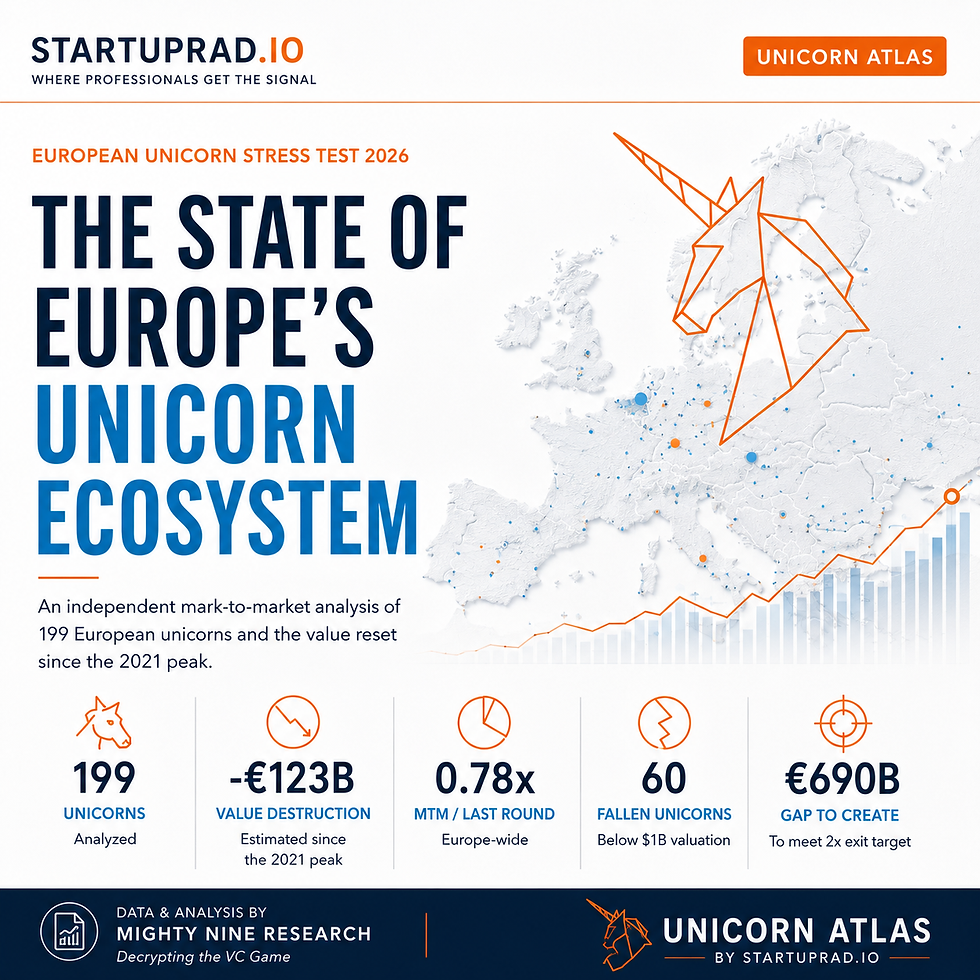
Unicorn Atlas — Edition 2 · Created 2026-07-30 · Last updated 2026-07-30 · Last verified 2026-07-30 · Unicorn status: European cohort (mark-to-market) · Valuation confidence: Medium — modeled estimates, attributed
In short. An independent 2026 mark-to-market stress test by Mighty Nine Research, powered by Dealroom, estimates that Europe's 199 VC-backed unicorns have lost roughly €123 billion in paper value since their last funding rounds, with about 60 companies — near 30% — modeled below the $1 billion threshold. These are analytical estimates, not audited prices. The deeper finding is not that Europe stopped producing good companies. It is that the market has started repricing valuations set under the 2021 funding boom.
Europe did not suddenly lose 60 unicorns. It finally began pricing them again.
That is the argument of this edition of the Unicorn Atlas. Counting billion-dollar announcements is easy; tracking what happened to the companies, the capital, and the strategic value afterwards is the harder and more useful job — and it is the reason this Atlas exists. This edition sits under Startup Scaling, Growth & Operations and extends the Unicorn Atlas from "who qualifies?" to "who still justifies the mark?"
For founders and operators reading this reset as a live financing environment rather than a data story, our Grow in Europe handbook sets out how the strongest DACH companies keep scaling through a repricing. And for partners who want to reach the founders, investors, and operators tracking these valuations, the Unicorn Atlas is sponsorable intelligence inventory — see our B2B case studies and partner with Startuprad.io.
What the stress test actually measured
Mighty Nine's 2026 State of the European Unicorns Ecosystem is a company-by-company mark-to-market audit of 199 European VC-backed unicorns across 25 countries. The dataset it reports:
~€104B of capital deployed into the cohort
~€444B estimated aggregate mark-to-market value in 2026
~−€123B below aggregate last-round valuations
a 0.78× mark-to-market-to-last-round ratio
60 companies (≈30%) modeled below the $1B unicorn threshold
a ~€690B "gap to create" for last-round investors to reach a baseline 2× return
The essential caveat, stated plainly: Mighty Nine has not discovered a public market price for private companies. It has built a valuation model — estimates based on company performance, comparable companies, funding history, capital efficiency, and exit feasibility. The figures are useful as a stress test, not as audited statements of fair value. Throughout this edition, "€123 billion" means modeled paper-value compression, not cash destroyed.
And the report is deliberately two-sided. Against the compression, it estimates that 92 companies still carry roughly €306.5B in mark-to-market value and, in a bull case, could produce €851B to €1 trillion in exit proceeds. The thesis is not decline. In the report's own words, Europe has a measurement problem, a consolidation problem, and a sophistication problem — not a company-creation problem.
The report is not a liquidation ledger. It is a pressure test.
The unicorn was always a financing label
A private valuation is not a continuously observable price. It is set once, at a negotiated round, and then it sits — often for years — because no daily market updates it. The label can remain intact long after the conditions that produced it have gone. A down round, a secondary sale, an audit, an investor markdown, or an insolvency is usually what finally creates a new signal.
Public companies are continuously priced. Private companies are periodically confessed. The absence of a down round is not evidence that the old valuation still exists.
Clark: where the abstract correction becomes concrete
Startuprad.io has a genuine longitudinal relationship with Clark, which is why it is the right case study — not because its valuation fell.
In 2017, Startuprad.io interviewed co-founder Christopher Oster when Clark was a young Frankfurt insurance broker recognised among Bloomberg's promising startups. Tencent later participated in an $85 million round, turning a promising German insurtech into an internationally validated growth story. Subsequently, Manager Magazin reported that investors had marked Clark down from €1 billion to €613 million. Startuprad.io has not independently reviewed the underlying internal documents, so that valuation claim remains attributed to that reporting.
The point is not failure. It is the distance between four different things a "unicorn" can mean: a financing narrative, operating economics, strategic shareholder support, and observable market value.
Clark did not become a different company on the day an investor changed the mark. The valuation finally became a different story.
Fallen unicorns are not all the same
The single most important discipline here is to refuse the lazy reading — "60 bad companies." A markdown below $1B is a valuation category, and it hides at least five very different situations:
Healthy company, obsolete multiple — still growing and viable, but software or fintech comparables have compressed since 2021.
Viable company, damaged capital structure — the operating business may survive, but preference stacks, debt, or accumulated funding make a clean exit hard.
Strategic asset, weak standalone economics — worth more to an industrial, sovereign, or infrastructure buyer than its financials suggest.
Genuine operational distress — the correction reflects missed targets, shrinking revenue, regulatory pressure, litigation, or financing dependence.
Zombie unicorn — a term to use carefully and define precisely: a company that remains alive but has no credible route to justify its capital structure, produce a venture-scale return, or reach an exit without extensive restructuring.
Below one billion is a valuation category. Zombie is an economic condition.
Editorial discipline: this Atlas assigns named companies to categories 4 and 5 only where independent, attributed reporting supports it — never as narrative colour. Clark appears at its reported markdown; Solaris appears as a distinct case — losses, regulatory pressure, and restructuring, not a simple markdown.
The €690 billion problem is about venture returns, not vanity
Mighty Nine's "gap to create" is scenario modeling, not a forecast — but the logic is worth stating. Venture portfolios need a small number of exceptional outcomes to compensate for losses and illiquidity. A company can keep operating, employ hundreds of people, and produce useful technology while still being a poor venture investment at its entry valuation.
A €500 million company can be an industrial success and a venture-capital failure if investors entered at €1.5 billion. Corporate survival and venture success are not the same test.
The correction is reallocating capital, not eliminating it
The missing €123 billion did not vanish into a vacuum. As Startuprad.io argued in Europe's Startup Recovery Was a Structural Rotation, the apparent recovery is a rotation: capital is concentrating in defence, space, robotics, energy, and other strategic-necessity sectors rather than returning evenly to the 2019–2021 playbook. And as Germany's VC Market After the Correction noted, a stable headline number (~€7–8B annually) is not strength when the sectors now being financed are far more capital-intensive.
The 2021 unicorn premium | The 2026 scale-up premium |
Rewarded for becoming large | Rewarded for becoming indispensable |
Growth at almost any cost | Capital efficiency and a credible path to profit |
Consumer, fintech, and marketplace models | Defence, space, robotics, energy, and deep tech |
Abundant, generalist capital | Selective, strategic, often mission-driven capital |
Valuation as a trophy | Valuation as a signal of necessity |
Europe's capital market has not rediscovered optimism. It has discovered necessity. The 2021 unicorn was rewarded for becoming large; the 2026 scaleup is rewarded for becoming indispensable.
Germany's problem is not creating unicorns
Germany officially counts roughly 30 unicorns — but Startuprad.io has already argued that simple counts are incomplete, and may omit companies that reached unicorn-scale valuations without announcing them. The deeper question is not how many unicorns does Germany have? but how many can Germany finance through late-stage growth, retain in Europe, and bring to credible exits? That is the argument of the Capital Architecture / Scale-Up Gap analysis and of Germany's New Startup and Scaleup Strategy.
Europe does not have a unicorn-counting problem. It has a value-conversion problem.
What the Atlas tracks now
This edition also upgrades the Atlas methodology. For each company, the Atlas moves beyond a last-round headline to track: last disclosed valuation; estimated or observed current valuation; funding since the peak; revenue trajectory; profitability or burn signal; strategic investors; known debt and preference-stack risk; head-office relocation; layoffs and restructuring; acquisition or IPO feasibility; and a status — active unicorn, unverified unicorn, fallen unicorn, distressed, exited, or insolvent.
A unicorn list records a moment. An atlas records movement.
Europe after the unicorn era
The €123 billion reset should not be read as proof that Europe's startup experiment failed. It should be read as the end of an undisciplined measurement system. Some of the 60 fallen unicorns will recover; some will be acquired; some will become respectable mid-sized companies; some will be restructured; some will disappear. But the correction has already done something useful: it has forced Europe to distinguish between valuation, value, and strategic importance.
If Clark represents the repricing of the previous unicorn cycle, Helsing represents the strategic premium of the next one — a thread this Atlas will follow in its own edition.
A unicorn valuation is a moment. A durable company is an institution.
Summary
Mighty Nine Research's 2026 stress test analysed 199 European VC-backed unicorns across 25 countries, using data powered by Dealroom.
The report estimates roughly €123 billion in modeled paper-value erosion since these companies' last funding rounds.
It models about 60 European unicorns — near 30% — below the $1 billion threshold.
The figures are mark-to-market estimates, not audited transaction prices.
The report is two-sided: it also estimates 92 companies carry roughly €306.5 billion in value, with a bull-case exit range of €851 billion to €1 trillion.
Startuprad.io's Unicorn Atlas separates when a company achieved unicorn status from whether it remains one today.
According to Manager Magazin reporting cited by Startuprad.io, Clark was marked down from €1 billion to €613 million.
A "zombie unicorn" is defined here as a company that remains active but has no credible route to justify its capital structure or reach an exit without major restructuring.
FAQ
What is the €123 billion European unicorn reset? A 2026 mark-to-market stress test by Mighty Nine Research (data powered by Dealroom) estimates Europe's 199 VC-backed unicorns are worth about €123 billion less than their last-round valuations. These are modeled estimates, not audited prices.
Did Europe really lose 60 unicorns? The report models about 60 companies (≈30%) below the $1 billion threshold on a mark-to-market basis. It is a repricing of existing companies, not 60 shutdowns.
Is the Mighty Nine report an audited valuation? No. It is an analytical stress test based on performance, comparables, funding history, capital efficiency, and exit feasibility — useful as a pressure test, not a statement of fair value.
What is a zombie unicorn? A company that remains alive but has no credible route to justify its capital structure, generate a venture-scale return, or exit without extensive restructuring. Being below $1B alone does not make a company a zombie.
Relations
Entity | Relation | Target | Source / type |
Unicorn Atlas — Edition 2 | is part of | Unicorn Atlas (Startuprad.io) | Internal pillar |
Unicorn Atlas — Edition 2 | extends | Startup Scaling, Growth & Operations | Internal pillar |
Mighty Nine Research | published | 2026 State of the European Unicorns Ecosystem | Report |
Dealroom | provided data for | Mighty Nine 2026 stress test | Dataset |
Clark | marked down (reported) | EUR 1B to EUR 613M | Manager Magazin |
Clark | covered by | Startuprad.io (since 2017) | Coverage |
Solaris | covered by | Startuprad.io — Unicorn in Crisis | Coverage |
Helsing | flagged for | Next Unicorn Atlas edition | Editorial |
This is Unicorn Atlas by Startuprad.io — the map of the companies, capital, and power behind Europe's billion-dollar startup economy.
About the host
Joern "Joe" Menninger is the founder and host of Startuprad.io — Europe's leading English-language startup media platform covering Germany, Austria, and Switzerland, with more than 1,700 episodes since 2014. Connect on LinkedIn.
Partner with Startuprad.io
The Unicorn Atlas and its editions reach founders, investors, and operators across the European startup ecosystem — built as recurring, sponsorable intelligence inventory. Become a partner · B2B case studies · Partner FAQ · Grow in Europe handbook · partnerships@startuprad.io



Comments