


Clark Reportedly Loses Unicorn Status: What Allianz's Markdown Says About Europe's Insurtech Reset
Updated: Aug 29
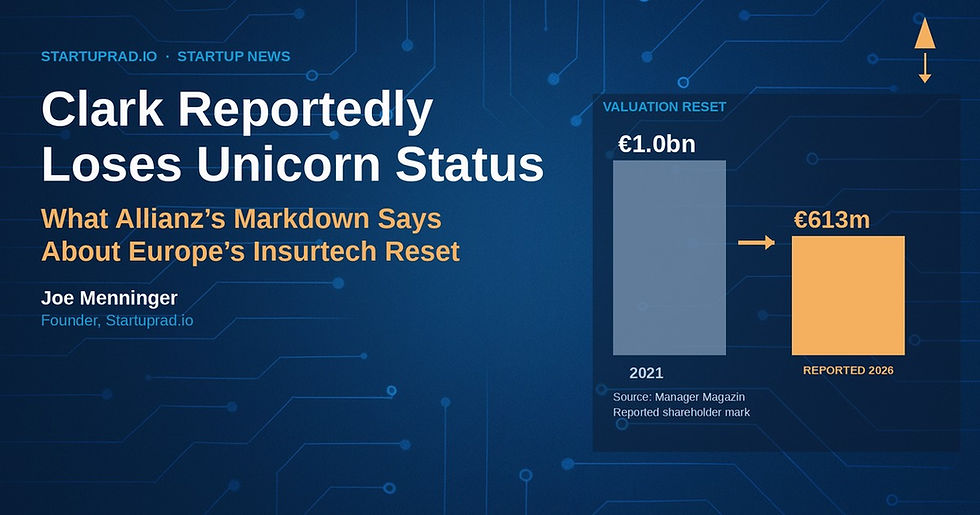
According to a new Manager Magazin report, the Frankfurt-based insurtech Clark — led by CEO Benedikt Kalteier — may have lost its unicorn status after investors reportedly marked the company down from €1 billion to €613 million. If accurate, the markdown places Clark among a growing cohort of European startups whose 2020–2021 valuation labels no longer survive contact with the current market. For Startuprad.io, the story has a longer arc than the headline. We first spoke with Clark co-founder Christopher Oster in 2017, when the company was being framed as one of Germany's most promising startups. We came back to Clark when Tencent backed the company's $85 million funding round. That makes the reported markdown less a single-company headline and more a case study in how Europe's startup narratives are being repriced.
What Is This About?
Manager Magazin reports that Clark, the Frankfurt insurance broker majority-backed by Allianz X, has been internally marked down from €1bn to €613m, alongside reported revenue decline, loss expansion, debt pressure, and a legal dispute. If the report is accurate, Clark would be one more European unicorn quietly dropping below the billion-euro threshold — and a useful window into how the unicorn label itself is being repriced.
What the Report Says
Manager Magazin's reporting, summarised in the magazine's "Topstory" framing under the line "Ziele verfehlt: Clark-CEO Benedikt Kalteier," describes a sharper valuation cut than most public down-rounds: investors reportedly mark Clark at €613 million, down from the €1 billion threshold that previously made it one of Germany's unicorns. The report further cites declining revenue, expanding losses, debt pressure, and a legal dispute that the magazine frames as a potential existence-level risk. It also raises the strategic question of whether Allianz, Clark's major shareholder via the Allianz X venture arm, will continue to support the company.
Startuprad.io has not independently reviewed the internal documents cited by Manager Magazin. Every operational claim in this article — the markdown, the revenue trajectory, the loss profile, the legal exposure, and the framing of shareholder posture — is attributed to that reporting. Manager Magazin is considered one of the leading business news outlets in Germany.
Why Losing Unicorn Status Often Happens Quietly
Public companies have a daily market price. Private companies have a valuation that only changes when something forces it to change, frequently in the accounting of their existing investors: a new funding round, a secondary transaction, an audit, a fund's quarterly mark, or a strategic investor's internal review. That is why a startup can lose unicorn status without a public collapse, without a formal "down round," and logically without a press release. A markdown can reflect several things at once — lower comparable multiples, missed plan, increased risk weight, debt overhang, litigation exposure — and a single investor's mark can drag the implied company valuation below the billion-euro line.
Three mechanics are worth knowing. First, valuations in private markets are anchored, not priced — anchored to the most recent round, and adjusted from there. Second, strategic investors like Allianz mark portfolio companies on their own balance sheets, which means the lead shareholder's view often becomes the company's de facto headline number. Third, valuation and operating reality are not the same variable: a company can be operationally healthy and still be marked down because the market has moved, and vice versa. Reading Clark's reported markdown through this lens matters: the €613 million number is a shareholder mark, not a transacted price.
From Bloomberg Promise to Valuation Reset: The Clark Arc
Clark is not a new company to Startuprad.io. In our 2017 interview with Clark co-founder Christopher Oster, Oster was discussing Clark's recognition as the only German startup on Bloomberg's 50 Most Promising Startups You've Never Heard Of list. At that point Clark was a young Frankfurt-based online insurance broker — not an insurer, not a balance-sheet risk-taker — built around a contract-transparency layer, a customer database, and a recommendation engine sitting on top of it. Oster described the German insurance market as a roughly €200 billion industry, larger than the entire German e-commerce sector by a factor of about 4.5x, and made the case that Frankfurt's financial-services talent pool justified building there rather than in Berlin.
The second Startuprad.io chapter came with the Tencent-backed $85 million round, which marked Clark's transition from a promising local broker into an internationally validated insurtech with Chinese tech capital on the cap table. That was the high-water mark of the narrative arc — international growth capital, distribution muscle through Allianz, and the unicorn label that came with the 2021-era funding climate.
The reported 2026 markdown closes the third chapter of that arc: early promise, international capital validation, and now private-market repricing. The interesting question is not whether Clark is "still" a unicorn. The interesting question is what the broker model now has to prove to the investors who are setting the new mark.
Why Insurtech Was Always Harder Than the Label
Insurance distribution is a category that punishes growth-at-all-costs. Customer acquisition is expensive because trust signals matter more than CPC arbitrage. Commission economics are bound by regulator-set ceilings and provider negotiation. Lifetime value depends on retention and cross-sell, both of which require operational depth — claims handling, advisor quality, contract management at scale — that does not show up in growth-stage pitch decks. Margin sensitivity is high because every layer of the value chain (insurer, broker, sub-broker, software vendor) takes a cut from premiums that are themselves a small share of policy notional value. None of this is new, and none of it was disguised. What changed between 2020 and 2026 is that the funding market is no longer paying for growth narratives that do not converge on durable unit economics.
For Clark specifically, the model Oster described in 2017 — transparency, database, and recommendations on top — is recognisable in today's company. The pressure point Manager Magazin describes is not the model itself; it is whether the model produces the unit economics the current market requires from a company that was once given a billion-euro label. This is the same shift Paolo Sironi mapped in our fintech and banking 2023+ strategy conversation: a category-wide move from growth-narrative pricing to distribution economics, embedded-finance scale, and regulatory-cost discipline.
Europe's Unicorn Reset Is No Longer Theoretical
How many European unicorns have lost their billion-euro valuation?
According to the Mighty Nine State of the European Unicorns Ecosystem report (2026), 60 of 199 VC-backed European unicorns — about 30 percent — have fallen below the $1 billion threshold since 2021. Aggregate value destruction across the cohort is €123 billion, with the group trading at roughly 0.78× its last-round valuation. Clark's reported markdown would add a Frankfurt insurtech to that list.
The Manager Magazin piece references the same Mighty Nine analysis, the first independent mark-to-market stress audit of Europe's 199 VC-backed unicorns across 25 countries. The German press picked up the report through FAZ's "Wenn Europas Einhörner ihr Horn verlieren" — when Europe's unicorns lose their horn — which is a useful cross-language validation of the same dataset. If Clark is added to that group, the symbolic story is that the unicorn label was always a funding-market signal — a snapshot of the multiple investors were willing to pay in a specific quarter, not a durable operating status.
The structural story is more interesting for DACH fintech as a category. Germany's fintech and insurtech wave of 2018–2021 produced a generation of companies that scaled distribution faster than they could scale economics. The next phase, the one Clark's reported markdown is part of, is about which of those companies can survive a higher cost of capital with the same product and the same regulatory environment. That is a much harder filter than the one that produced the labels.
Clark Was Also a Frankfurt Story
One angle is easy to miss. Clark was an explicit bet on Frankfurt as a startup location — built around insurance-adjacent talent, geographically close to the buyers and underwriters Clark needed, and deliberately not Berlin. Oster made that case in 2017. Frankfurt eventually got its first proper unicorn in 2021, the same vintage as Clark's billion-euro label, and the Rhein-Main ecosystem has since been working to prove the bet beyond a single round of high valuations. Whatever happens to Clark's mark now, the company remains part of that larger Frankfurt narrative: the attempt to build digital financial-services companies inside the regulated, finance-heavy Rhein-Main corridor rather than inside Berlin's consumer-startup gravity well. That bet is now being tested by the harder market it has to operate in, not by the city it chose.
What This Means
Clark's reported markdown does not erase the company's role in Germany's insurtech story, and it does not — based on the available reporting — settle the question of whether the business itself is viable. What it does change is the interpretation: from a representative success of the 2021 unicorn class, to a representative case in the 2026 European unicorn correction. The lesson for founders, investors, and ecosystem observers is not that one Frankfurt insurtech missed plan. It is that Europe's startup market is leaving the symbolic-valuation era and entering a more demanding phase: revenue quality, capital discipline, legal resilience, and the ability to keep strategic investors convinced after the funding boom has ended.
Joe Menninger is the founder of Startuprad.io, an English-language editorial intelligence platform covering the DACH (Germany / Austria / Switzerland) startup ecosystem. He has interviewed Clark's leadership across two funding chapters since 2017.
Entity Relationships
Core deal
Clark (Frankfurt-based insurance broker) is reportedly marked from €1bn to €613m by its shareholders, per Manager Magazin reporting (2026-05-20).
Capital and ownership
Allianz, via Allianz X, is described as Clark's major shareholder; whether Allianz continues to support the company is treated as the central strategic question in the Manager Magazin report.
Company structure and leadership
Clark is led by CEO Benedikt Kalteier; co-founder Christopher Oster was Startuprad.io's interview partner in 2017 when Clark first appeared on Bloomberg's promising-startups list.
Capital history
Tencent led an $85 million Clark funding round previously covered by Startuprad.io, marking the company's transition from local broker to internationally validated insurtech.
Geopolitical and regulatory context
Clark operates in the German insurance market (roughly €200bn in annual premiums) under BaFin supervision, which constrains broker commission structures and distribution practices.
Macro context
The Mighty Nine State of the European Unicorns Ecosystem report (2026) finds that 60 of 199 European VC-backed unicorns across 25 countries have fallen below the $1B threshold, with aggregate value destruction of €123B and a 0.78× mark-to-market / last-round ratio. Clark, if Manager Magazin's mark is accurate, sits inside that cohort — and the German press picked the report up via FAZ.


Comments