


GDPR as a B2B Sales Barrier: What German Buyers Need Before They Sign
Updated: 1 day ago
What Is This About?
GDPR rarely kills a German B2B deal outright. It stalls it. This is a practical guide for foreign vendors selling software or services into Germany: which three documents the buyer's data-protection function actually needs, why that function behaves the way it does, and how to arrive already cleared.
Most foreign vendors treat GDPR as a legal problem to be solved after the commercial terms are agreed. German buyers treat it as an admission ticket. That mismatch is where deals go to die — not in a rejection email, but in a four-week silence while an under-resourced internal data-protection function tries to work out whether approving you creates personal liability for the person signing. Understanding this is a core part of DACH B2B positioning: the German market does not reward vendors who are technically compliant, it rewards vendors who are reviewable.
The distinction matters commercially. A compliant vendor can pass an audit. A reviewable vendor lets a stranger inside the buyer's organisation reach a defensible "yes" in one sitting, with the documents in front of them, without escalating to outside counsel. In 2026, with international transfers still legally unsettled and a German data-protection profession that is measurably short-staffed, reviewability is the scarcer asset — and it is the one you can actually manufacture before the first call.
Executive Summary
German buyers do not evaluate your GDPR posture as lawyers. They evaluate it as risk-holders operating with incomplete information and no spare capacity. Bitkom's ten-year longitudinal survey of German companies found that in 2025, 82 percent named uncertainty about the exact data-protection requirements as one of their biggest challenges, 38 percent reported a shortage of qualified data-protection staff — the highest figure in the series — and of the 86 percent who sought help from supervisory authorities, only 36 percent were satisfied with what they got. A function that is uncertain, understaffed, and poorly supported does not experiment. It pushes the burden outward, onto you. The vendors who win in Germany are the ones who arrive with the paperwork finished and the transfer story pre-argued.
Key Takeaways
GDPR is a gating problem, not a closing problem. It stops deals in the middle of the funnel, silently, and the loss is usually recorded as "went quiet" rather than "failed compliance review."
Your German buyer's data-protection function is measurably under-resourced. In 2025, 38 percent of German companies reported a shortage of qualified data-protection personnel — the highest reading since Bitkom began tracking it in 2016.
Three documents decide the outcome: the Auftragsverarbeitungsvertrag (Art. 28 processor contract), the TOM annex (Art. 32 technical and organisational measures), and the transfer file (Art. 44–49 plus a current sub-processor list).
61 percent of German companies transferred personal data to the United States in 2025 — it remains by far the most important non-EU destination — and 71 percent want workable political solutions for international transfers, up from 32 percent in 2021. Your transfer story is not a formality.
The EU–US Data Privacy Framework is valid law today, but it is under appeal at the Court of Justice. Sell against that uncertainty by offering an EU hosting option, not by dismissing it.
Who Actually Blocks the Deal
The buyer segment for this problem is narrower than "German companies." It is any German or DACH-headquartered organisation that will process personal data through your product — customer records, employee records, prospect data, support tickets, telemetry that can be linked to a person — and that has, formally or informally, someone accountable for data protection. In practice this covers:
Mittelstand firms with 50–500 employees, where the Datenschutzbeauftragter is usually an external consultant on a retainer, reachable a few days a month, or an internal employee doing the job alongside a full-time role.
Enterprises above 500 employees, where there is a real privacy team, a documented vendor-review process, and a standard DPA template you will be asked to sign rather than to supply.
Regulated buyers — financial services, healthcare, insurance, public sector — where data protection sits on top of sector rules and the review runs longer by default.
Funded startups and scaleups, who care less about form and more about whether you will slow down their own enterprise sales cycle downstream.
The common feature is that the person who blocks you is almost never the person who wants to buy from you. Your champion cannot overrule them, and in most German organisations will not try.
The Datenschutz Gate: Three Documents That Decide Your Deal
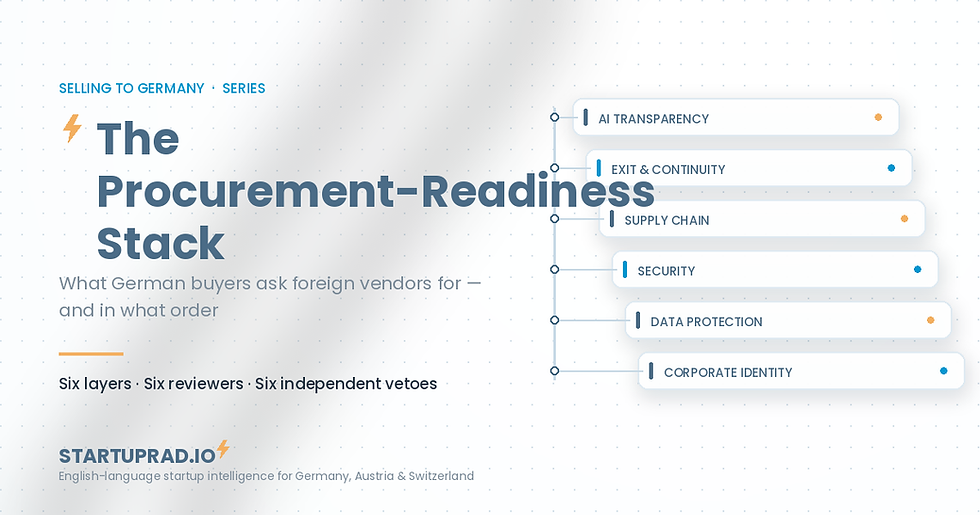
Think of GDPR as one layer of the wider procurement-readiness stack a foreign vendor has to satisfy in Germany — the layer that sits between commercial agreement and legal signature, downstream of how B2B procurement actually works here. It has three checkpoints, and they are checked in order.
1. The paper — the Auftragsverarbeitungsvertrag. Under Article 28 GDPR, where you process personal data on the buyer's behalf, a written contract with prescribed content is mandatory. German buyers call it the AVV, and it is the single most-searched data-protection term in the German market. If you do not have one ready in German and English, you have already introduced a delay. If you cannot accept the buyer's template with limited redlines, you have introduced a negotiation.
2. The place — the TOM annex. Article 32 requires appropriate technical and organisational measures. In Germany this is not a paragraph of prose; it is an annex, structured by measure category, that the buyer's reviewer can tick through. Encryption at rest and in transit, access control, pseudonymisation, availability and resilience, restore testing, and a stated review cadence. A one-page "we take security seriously" statement reads, to a German reviewer, as an absence of evidence.
3. The proof — the transfer file. If any personal data leaves the EEA, Chapter V of the GDPR applies, and the buyer needs to see how you have handled it: the legal mechanism you rely on, your current sub-processor list with locations, and — for US transfers — a clear statement of whether you are certified under the EU–US Data Privacy Framework or relying on the Standard Contractual Clauses with a transfer impact assessment.
A German buyer is not asking whether you are compliant. They are asking whether approving you is defensible if someone reviews the decision in two years.
Where the Gate Sits in the Buying Journey
The gate is almost always crossed later than foreign vendors expect and earlier than they are prepared for.
Discovery and demo. No data-protection involvement. The vendor believes the deal is progressing normally, because it is.
Technical validation or pilot. The first request appears — usually "can you send your DPA and TOMs?" — often from IT or the champion, not from a lawyer. This is the moment the deal is actually won or lost. Vendors who answer within 24 hours with a complete pack change the temperature of the deal.
Formal review. The data-protection function reads what you sent. If personal data of employees is involved, the works council may be triggered in parallel — a separate and often slower gate.
Legal and signature. Redlines, sub-processor consent mechanics, audit rights, deletion timelines.
Post-signature. Sub-processor change notices, annual TOM refresh, incident reporting obligations.
Step 2 is where the timeline is set. Everything after it is a function of how complete your answer was.
Procurement and Regulation: What Changed by 2026
Three developments matter to how a German buyer reads your transfer story right now.
The EU–US Data Privacy Framework is valid, but contested. The European Commission adopted its adequacy decision for the DPF in July 2023. It was challenged, and on 3 September 2025 the EU General Court dismissed the action brought by Philippe Latombe, upholding the framework. Latombe appealed, and the case is now pending before the Court of Justice. Nothing has been struck down. But German privacy professionals remember Safe Harbour and Privacy Shield, and they price the tail risk into their review.
Transfers remain the unsolved problem in practice. Bitkom's 2026 report found that 61 percent of German companies transferred personal data to the US in 2025 and that 71 percent want durable political solutions for international transfers — more than double the 32 percent who said so in 2021. Your buyer is doing this too. They are not hostile to US vendors; they are tired of defending the arrangement.
The Digital Omnibus has not yet relieved anyone. The AI half of the package was adopted in 2026 and shifted several AI Act deadlines. The data half — the one that would amend the GDPR itself — remains in negotiation. Do not build a sales argument on rules that have not passed. German reviewers will discount it.

What Foreign Vendors Get Wrong
They send the DPA after the commercial close. By then the buyer's reviewer has been given a deadline and a document they have never seen, which is the worst possible combination. Send it at first technical contact instead.
They offer a US-only DPA and a US-only architecture. A US-governed contract with no EU hosting option converts a routine review into an escalation. An EU or German region — even at a premium — removes the single hardest question from the buyer's file.
They confuse certification with an answer. SOC 2 is a useful signal and not a substitute. A German reviewer will read your SOC 2 report and then still ask for the TOM annex, because Article 32 asks a different question than SOC 2 does.
They argue with the template. Many German buyers, especially above 500 employees, will send their own AVV. Redlining it heavily signals that you are unfamiliar with the market. Accept what you can live with, flag the two or three clauses that genuinely break your operating model, and explain why in German-legal terms rather than in commercial ones.
They treat the works council as a legal afterthought. Where your product touches employee data or could be used to monitor performance, a separate co-determination process applies — the Betriebsrat problem — and it does not run on your quarter. Foreign vendors routinely discover this in month three.
They let the champion carry the review. Your champion is not equipped to defend your architecture to their own DPO. Give them a two-page summary written for the reviewer, not for them.
The Practical Checklist: Arrive Gate-Ready
Before your first German enterprise conversation, have all of this ready to send as one file:
An Auftragsverarbeitungsvertrag in German and English, pre-signed by you, drafted against Article 28(3).
A TOM annex structured by measure category, dated, with a stated review cadence.
A current sub-processor list with company name, purpose, country of processing, and a change-notification commitment.
A transfer statement: your Chapter V mechanism, DPF certification status if applicable, and your transfer impact assessment summary.
Data location options, including at least one EU region, stated as a commercial option with a price rather than as a future roadmap item.
Deletion and return terms: what happens to the data at termination, in what format, within how many days.
Incident handling: your notification timeline to the controller, contact channel, and named responsible role.
A DPIA support pack — the input the buyer needs if their processing requires a data-protection impact assessment under Article 35.
A named privacy contact who answers in one business day and can hold a conversation in German.
If a German buyer asks for something on this list and your answer is "we'll get back to you," you have just added two weeks to the cycle.
The Startuprad.io Perspective
The uncomfortable read on all of this is that GDPR functions as a market-structure advantage for incumbents, and foreign vendors keep mistaking it for a legal obstacle. Incumbent European vendors are not more compliant than you. They are more pre-cleared — their paperwork has already been through hundreds of German reviews, their hosting is already in Frankfurt, and their sales motion assumes the gate exists. They budgeted for it. You are improvising at it.
That is also the good news, because pre-clearance is cheap relative to what it protects. Building the three-document pack is a few weeks of legal and engineering work, done once. The deals it unblocks are recurring. In a market where 97 percent of companies report high data-protection effort and none report it falling, the vendor who visibly reduces that effort is not selling compliance — they are selling relief, and relief is a differentiator that German buyers can actually feel.
This connects directly to the first rule of the franchise: German buyers Google you before they reply. Your data-protection posture is part of what they find.
More in the Selling to Germany Series
Why German Buyers Google You Before They Reply — the first-contact credibility check
The EU AI Act and Foreign AI Vendors Selling to German Buyers — the parallel regulatory gate for AI products
How German Companies Buy B2B Products by Company Size — segment-by-segment buying behaviour
The Betriebsrat Problem: Why Works Councils Can Stall Your German Software Deal — the co-determination gate
How B2B Procurement Actually Works in Germany — the full procurement process
How German Mittelstand Companies Buy Software — the Mittelstand buying motion
DACH Regulatory Reality: GDPR, BaFin, and the Compliance Moat — the wider regulatory landscape
Selling into Germany and hitting the compliance gate? Startuprad.io works with foreign vendors and market-entry teams building credibility with German and DACH buyers before the first sales conversation. Book a 20-minute conversation to talk through your positioning, your evidence base, and where your entry motion is leaking.
Frequently Asked Questions
Is GDPR really a sales barrier, or just paperwork?
It is a timing barrier. Nothing in the GDPR prohibits a German company from buying from a foreign vendor. What it does is insert a review step, controlled by someone who is not your buyer, at exactly the point where momentum matters most. Vendors who prepare for that step compress it to days; vendors who do not routinely lose four to eight weeks.
Do we need a German-language DPA, or is English enough?
Legally, English is usually sufficient between commercial parties. Practically, a German version removes friction with external Datenschutzbeauftragte, works councils, and mid-market legal teams who will otherwise have it translated or delayed. The cost of producing one is trivial compared to a single stalled deal.
Can we still transfer personal data to the United States in 2026?
Yes. The European Commission's 2023 adequacy decision for the EU–US Data Privacy Framework remains in force, and the General Court upheld it in September 2025. An appeal is pending at the Court of Justice, so German buyers will still want to see your fallback — Standard Contractual Clauses plus a transfer impact assessment — alongside any DPF certification.
Will the EU Digital Omnibus make this easier?
Not yet, and not in time for your current pipeline. The AI-related part of the package was adopted in 2026; the part that would amend the GDPR itself is still under negotiation. Sell against the rules as they are today.
Who actually has to approve us on the buyer's side?
Typically the data-protection officer or an external Datenschutzbeauftragte, with input from IT security, and — where employee data or monitoring capability is involved — the works council. Procurement coordinates, but it does not overrule any of them.
Entities
Startuprad.io → publisher and DACH startup intelligence platform
General Data Protection Regulation (GDPR / DS-GVO) → EU Regulation 2016/679, the governing framework
Bitkom e.V. → German digital industry association, source of the 2026 ten-year GDPR longitudinal study
Bitkom Research → survey operator, 603 German companies with 20+ employees, representative
EU–US Data Privacy Framework → European Commission adequacy decision, July 2023
Court of Justice of the European Union → hearing the pending Latombe appeal against the DPF
EU General Court → dismissed the Latombe challenge, 3 September 2025
Philippe Latombe → French parliamentarian, DPF challenger
Standard Contractual Clauses → Commission Implementing Decision (EU) 2021/914, transfer fallback mechanism
EU Digital Omnibus → 2025–2026 EU legislative package; AI part adopted, data part still in negotiation
Auftragsverarbeitungsvertrag (AVV) → German term for the Article 28 data-processing agreement
Datenschutzbeauftragter → German data-protection officer, internal or external
Betriebsrat → German works council, parallel approval gate for employee data
About the Author
Joern "Joe" Menninger is the founder of Startuprad.io, Europe's leading English-language startup media platform covering the DACH region. With 740+ podcast episodes and over 1 million annual streams, Startuprad.io connects founders, investors, and corporate innovators across Germany, Austria, and Switzerland. Connect on LinkedIn
Created with the assistance of AI.
For the full market-entry picture, see how to approach the German-speaking B2B market.


Comments