


The Procurement-Readiness Stack: What German Buyers Ask Foreign Vendors For
Updated: 2 hours ago
What Is This About?
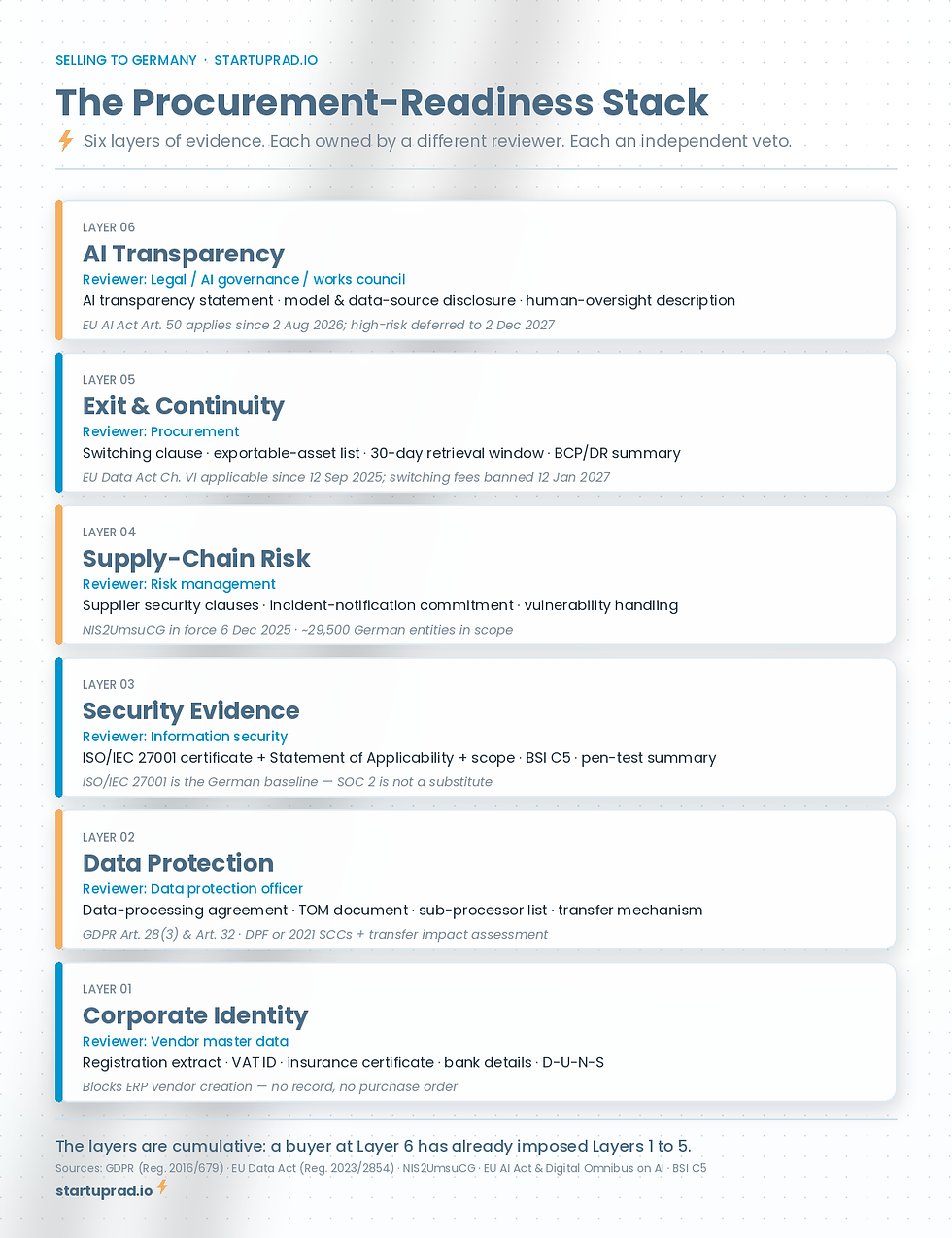
German buyers do not ask foreign vendors for documents at the end of a deal. They ask early, in a fixed order, and a missing artefact stops the process rather than slowing it. The Procurement-Readiness Stack is the six-layer evidence set a foreign B2B vendor needs assembled before the first request arrives.
Introduction
Most foreign vendors selling into Germany discover the documentation layer the way you discover a pothole: at speed, and too late. A deal is progressing, the champion is enthusiastic, and then a security questionnaire arrives with 180 rows, a data-protection officer asks for the Auftragsverarbeitungsvertrag, and procurement wants the exit plan in writing. Three weeks of scrambling later, the quarter has moved.
This is not German bureaucracy for its own sake. Each of those requests comes from a named reviewer with statutory or contractual standing, and each one exists because a specific law or standard put it there. The requests are predictable. What is not predictable is whether the vendor has the answers ready.
This post sits inside Startuprad.io's series on go-to-market in Europe and Germany, which maps the institutional gates a foreign vendor has to clear to sell into the German-speaking market. Earlier posts in the series explained how B2B procurement actually works in Germany and why deals stall inside it. This one is the vendor-side answer: not what the buyer does, but what you must already hold when they do it.
Executive Summary
German B2B buyers run vendor evaluation as a documentary process, not a conversational one. Six distinct layers of evidence are requested — corporate identity, data protection, security, supply-chain risk, exit and continuity, and, where relevant, AI transparency — and each layer is owned by a different reviewer with an independent veto. Three of those layers changed materially between September 2025 and August 2026: the EU Data Act's cloud-switching regime, Germany's NIS2 implementation act, and the AI Act's Digital Omnibus deferral. Vendors assembling the stack per deal lose weeks that vendors holding it as a standing asset do not.
Key Takeaways
The Procurement-Readiness Stack has six layers; each is owned by a different reviewer, and any one of them can stop a deal independently of the others.
Documentation requests are a shortlisting filter, not closing paperwork — they typically arrive before commercial terms, not after.
SOC 2 is not the native currency of German security review. ISO/IEC 27001 with a scoped Statement of Applicability is, and for cloud services sold into the public sector or regulated industries, so is a BSI C5 attestation.
Germany's NIS2 implementation act has been in force since 6 December 2025, pushing supplier-security obligations down to vendors who are not themselves in scope.
The EU AI Act's high-risk deferral to December 2027 changed the enforcement date, not the buyer's question. German buyers are asking now.
Who Actually Triggers the Stack
Not every German buyer runs all six layers. The trigger is structural, and it maps onto the buyer segments defined in the series hub.
Sub-threshold buyers — purchases below a company's internal second-signature limit — typically ask for Layer 1 and a data-processing agreement, and nothing else. Threshold-crossing mid-market buyers add security evidence. Large enterprises, regulated industries and the public sector run all six, and run them in parallel rather than in sequence — the pattern described in how German enterprises evaluate foreign vendors. The stack is also what determines your sales motion rather than the other way round: as the comparison of digital-only, digital-first and relationship-led selling set out, a self-serve motion survives only where the buyer never reaches Layer 3.
The practical consequence is that the stack is not an enterprise-only problem. As the series has documented in how German companies buy B2B products by company size and how German Mittelstand companies buy software, a €40,000 deal at a 300-person Mittelstand manufacturer can carry a heavier documentation burden than a larger deal at a digital-native scale-up, because the manufacturer's customers are themselves in a regulated supply chain.
The Six Layers
Layer 1 — Corporate identity. Owned by vendor master-data administration. Company registration extract, VAT identification number, bank details on company letterhead, liability insurance certificate, and increasingly a D-U-N-S number. Unglamorous, and the single most common cause of a "won" deal that cannot be invoiced: the vendor record cannot be created in the buyer's ERP system, so no purchase order can be raised.
Layer 2 — Data protection. Owned by the data protection officer. A data-processing agreement meeting the content requirements of Article 28(3) GDPR, a written description of technical and organisational measures under Article 32, a current sub-processor list, and a documented transfer mechanism for any personal data leaving the EEA. For US vendors that means either certification under the EU-US Data Privacy Framework or the 2021 Standard Contractual Clauses plus a transfer impact assessment. The Framework's adequacy decision remains valid — the General Court dismissed the Latombe challenge on 3 September 2025 — but the appeal is pending before the Court of Justice as Case C-703/25 P, and sophisticated German buyers now ask what the fallback is. Have an answer. The series covers this layer in depth in GDPR as a B2B sales barrier.
Layer 3 — Security evidence. Owned by information security. An ISO/IEC 27001 certificate is the baseline expectation, and the certificate alone is not sufficient — reviewers read the Statement of Applicability and the scope statement to check whether the certified scope actually covers the product being sold. For cloud services, the German federal information security office's Cloud Computing Compliance Criteria Catalogue (C5) is the reference attestation for public-sector buyers and is increasingly requested by private-sector ones. Add a penetration-test summary you are willing to share and a pre-completed answer set for the standard questionnaire formats.
Layer 4 — Supply-chain risk. Owned by risk management, and new in its current form. Germany's NIS2 implementation act, the NIS2UmsuCG, was promulgated on 5 December 2025 and entered into force the following day with no transition period, bringing roughly 29,500 German organisations into scope. Those entities are required to manage risk in their relationships with direct suppliers — which means the obligation arrives at your door as contract clauses, incident-notification commitments and evidence requests even though you are not in scope yourself. NIS2 vendor due diligence covers what buyers are now required to ask.
Layer 5 — Exit and continuity. Owned by procurement. Since 12 September 2025, Chapter VI of the EU Data Act has applied to cloud and data-processing services, and it is prescriptive: contracts must carry an express switching right, a notice period no longer than two months, a data-retrieval window of at least 30 days, and an exhaustive advance list of exactly which data and digital assets are exportable. Switching charges are cost-capped now and prohibited entirely from 12 January 2027. An exit plan that reads as a reassuring paragraph rather than a contractual clause now fails on its face.
Layer 6 — AI transparency. Owned by whoever the buyer has made accountable for AI governance — often legal, and where the product touches employee data or anything readable as performance measurement, the works council, which holds statutory co-determination rights and an independent veto. The Digital Omnibus on AI, published in the Official Journal on 24 July 2026 and in force from 27 July 2026, deferred the Annex III high-risk obligations from 2 August 2026 to 2 December 2027, and the Annex I product-embedded obligations to 2 August 2028. What it did not defer: Article 50 transparency duties, which have applied since 2 August 2026. The series covered the deferral in what foreign AI vendors still need. The commercial point is simpler than the legal one — buyers who have built an AI intake questionnaire are not going to un-build it because a deadline moved.
What Foreign Vendors Get Wrong
For the full market-entry picture, see the European growth guide for B2B vendors.
They treat the stack as closing paperwork. It is a shortlisting filter. As why German buyers Google you before they reply documented, German buyers research silently and shortlist before making contact. By the time a questionnaire reaches you, you are already being compared against a vendor who answered it in two days. This is the moment where being findable, credible and already-evidenced in the German market decides the outcome — which is exactly what an ecosystem presence buys you, and why partnering with a DACH-native media platform does commercial work that outbound cannot.
They send SOC 2 where ISO 27001 was asked for. A SOC 2 Type II report is a serious document and it is not a substitute. German reviewers are trained on ISO 27001 structure and will treat a substitution as a gap, not an equivalent.
They read the AI Act deferral as permission to wait. The deferral moved a regulator's enforcement date. It did not move the buyer's intake form.
They assemble per deal. The same eight documents get rebuilt by a different person under time pressure for each opportunity, with drifting answers across deals — which is itself a finding when a buyer compares your questionnaire against the one you filed with their sister company.
They send documents without a scope statement. A certificate that covers a different legal entity or a different product line is worse than no certificate: it reads as either carelessness or misdirection.
The Procurement-Readiness Checklist
Assemble once, store in one place, assign one owner, review quarterly:
Company registration extract, VAT ID, insurance certificate, bank details on letterhead, D-U-N-S number
Data-processing agreement template drafted to Article 28(3) GDPR, ready to sign without legal review
Technical and organisational measures document, versioned and dated
Current sub-processor list with locations and a notification commitment
Transfer mechanism documentation: Data Privacy Framework certification or 2021 Standard Contractual Clauses plus transfer impact assessment
ISO/IEC 27001 certificate with Statement of Applicability and an explicit scope statement; BSI C5 attestation where cloud services meet public-sector or regulated buyers
Penetration-test summary cleared for external sharing
Pre-answered security questionnaire bank covering the standard formats
Supplier security clause set and incident-notification commitment aligned to NIS2 expectations
Data Act-compliant exit and switching clause, with the exportable-asset list written out
AI transparency statement, model and data-source disclosure, human-oversight description
Business continuity and disaster recovery summary
A German-language cover sheet for each item is not legally required and is disproportionately effective.
The Startuprad.io Perspective
The vendors that win German enterprise deals are rarely the ones with the best product on the shortlist. They are the ones who removed every reason to be eliminated before the shortlist was drawn.
That reframes the documentation layer from cost to asset. Assembled once, the Procurement-Readiness Stack is a standing capability that compresses evaluation cycles across every subsequent deal. Assembled per deal, it is a recurring three-week tax paid at the worst possible moment in the quarter — and paid again on the next one.
The pattern this series keeps returning to is that German institutional friction is not an obstacle to be charmed past. It is a filter, it is documented, and it is therefore winnable by preparation rather than by relationship. Credibility beats targeting; evidence beats enthusiasm. The stack is where that becomes operational.
Frequently Asked Questions
Do I need a German legal entity to sell into Germany?
No. A foreign entity can contract, invoice and deliver into Germany without a German subsidiary. What it needs is a complete and consistent Layer 1: registration documents, a valid VAT identification number, and details that match across every document. Vendor master-data teams reject on inconsistency far more often than on foreignness.
Is SOC 2 ever accepted instead of ISO 27001?
Sometimes, at digital-native buyers and startups. It is rarely accepted at Mittelstand manufacturers, regulated industries or the public sector. If you hold SOC 2 and expect to sell upmarket in Germany, treat ISO/IEC 27001 as a pipeline investment rather than a compliance expense, and in the meantime supply a mapping document showing which SOC 2 controls answer which ISO 27001 clauses.
Does NIS2 apply to me if I am not in a covered sector?
Not directly. Its practical reach is contractual: entities that are in scope must manage risk across their direct suppliers, so the obligations they carry are passed to you through your contract with them. You will meet NIS2 as a clause and a questionnaire long before you meet it as a regulator.
How long does full German enterprise vendor onboarding take?
For a vendor holding the complete stack, weeks. For a vendor assembling it reactively, a quarter or more — and the delay is almost never the buyer's review speed. It is the vendor's response latency on each request, compounded across six independent reviewers who are not waiting in a queue for each other.
Which layer should a vendor build first?
Layer 2. Data protection is requested in almost every deal regardless of size or sector, it is the cheapest layer to complete, and a signature-ready data-processing agreement removes the most common early-stage stall in the German market.
Work With Us
Startuprad.io is the English-language authority on the German, Austrian and Swiss startup and technology ecosystem. We help B2B companies reach DACH decision-makers — founders, investors, and corporate innovation leaders — through podcast partnerships, sponsored content and co-created editorial that builds the credibility German buyers look for before they reply.
If you are building a presence in the German-speaking market and want your company to be the one buyers have already heard of when procurement starts, become a Startuprad.io partner.
Entities
Startuprad.io → publisher → this series
Germany, Austria and Switzerland → market → the buying environment described here
GDPR → regulation → Layer 2, Articles 28(3) and 32
EU-US Data Privacy Framework → transfer mechanism → Layer 2, appeal pending as Case C-703/25 P
ISO/IEC 27001 → standard → Layer 3, the German security baseline
BSI (Bundesamt für Sicherheit in der Informationstechnik) → authority → Layer 3, publisher of the C5 catalogue
NIS2UmsuCG → German law → Layer 4, in force 6 December 2025
EU Data Act → regulation → Layer 5, Chapter VI switching regime applicable since 12 September 2025
EU AI Act → regulation → Layer 6, Digital Omnibus deferral in force 27 July 2026
Mittelstand → buyer segment → the mid-market that triggers the stack earlier than vendors expect
About the Author
Joern "Joe" Menninger is the founder of Startuprad.io, Europe's leading English-language startup media platform covering Germany, Austria and Switzerland. With 740+ podcast episodes and over 1 million annual streams, Startuprad.io connects founders, investors, and corporate innovators across the region. Connect on LinkedIn
Created with the assistance of AI.


Comments