


How the German Mittelstand Buys Factoring: What Foreign Finance Providers Get Wrong
What Is This About?
Factoring is one of the few financial services the German Mittelstand buys at scale: member companies of the Deutscher Factoring-Verband turned over €423.5 billion in 2025. This post explains who decides, how the buying journey runs, what BaFin licensing means for foreign providers, and what a vendor must prepare before an owner-manager takes the call.
Why Finance Is a Different Kind of Sale
This post sits inside Startuprad.io’s series on go-to-market in Europe and Germany, which maps the institutional gates a foreign vendor has to clear to sell into the German-speaking market. Most of that series deals with software. Financial services add a gate that software mostly avoids: the law decides who may sell before the buyer decides who should.
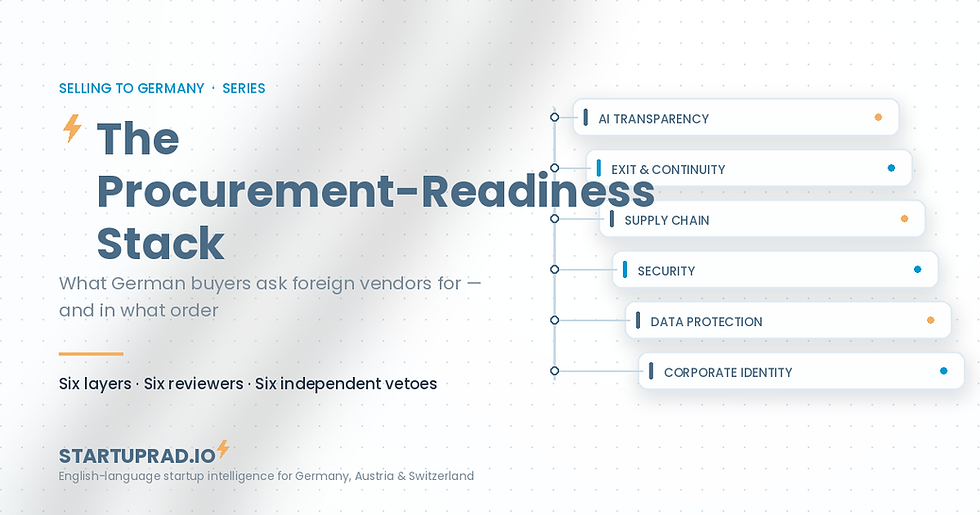
Factoring, the sale of a company’s invoices to a specialist provider in exchange for cash now, is a useful test case. It is a large, mature and well-documented market in Germany, it is bought mainly by owner-managed companies, and a foreign provider cannot treat it as a product launch. Earlier posts showed how German Mittelstand companies buy software and what the Procurement-Readiness Stack asks of a vendor. This post applies the same logic to a regulated product.
The evidence base is deliberately narrow: the Deutscher Factoring-Verband’s 2025 market figures, IfM Bonn’s Mittelstand statistics, BaFin’s own guidance on factoring and two provisions of German law. Where the sources do not settle a question, the post says so and flags it for legal review instead of guessing.
Executive Summary
Germany’s factoring market is large and still growing, and its buyers are mostly owner-managed companies in trade, healthcare and food. Selling into it means passing three tests in sequence: being allowed to offer the service at all, being credible to an owner-manager who decides personally, and putting contract and data terms in front of that owner before they have to ask. Foreign providers tend to lead with price and product, which is the last thing the buyer is evaluating. The providers that win prepare licence evidence, German-language material and a clear customer-communication model before outreach starts.
Key Takeaways
The market is large and growing. Deutscher Factoring-Verband members reported €423.5 billion in turnover in 2025, up 6.2%, with 112,000 clients.
Factoring is licensed. BaFin treats factoring as a financial service requiring authorisation under section 32(1) KWG; the EEA route in section 53b KWG is written for CRR credit institutions.
The buyer is an owner-manager. In the Mittelstand the managing director is often owner, budget holder and veto in one person.
Evidence beats pitch. Licence status, German-language terms and a clear account of how customers are informed decide the shortlist before price does.
Search is digital, the decision is not. Buyers research in German, then decide through relationships and advisers.
Who Is the Buyer?
The buyer is the owner-managed Mittelstand company. IfM Bonn counts more than 3.5 million SMEs in Germany, over 99% of private-sector companies. They employ close to 22 million of roughly 40 million people and generated about €2.8 trillion in turnover in 2024, 29% of the national total. That headcount follows the European Commission’s SME definition; the Mittelstand itself is a qualitative idea, in which the owners also run the company.
The product category is client-initiated factoring: a company sells its trade receivables to a factor and receives funds ahead of the customer’s payment date. Reverse factoring, which a large buyer sets up for its suppliers, is a different sale with a different decision-maker and is not covered here. The Deutscher Factoring-Verband (DFV) reports that trade is the largest factoring sector, followed by healthcare and the food industry.
The market is not small. DFV members reported €423.5 billion in turnover for 2025, up 6.2% on the year, with national factoring at €302.9 billion (up 8%) and international factoring at €120.5 billion (up 1.9%). Export factoring grew slightly and import factoring fell 2.8%. In total 112,000 clients used member services. The association’s 47 members represent about 97% of organised factoring turnover in Germany, so these figures describe the organised market rather than every provider.
Gate One: You Must Be Allowed to Sell It
In software, nobody asks whether you may sell. In factoring, BaFin does. BaFin’s guidance classes factoring as a financial service, and offering it commercially in Germany needs authorisation under section 32(1) of the German Banking Act (KWG), with the service defined in section 1(1a) KWG. A provider without that status is not a weaker competitor; it is not a competitor at all.
Foreign providers often assume the EU passport settles this. It may, but the route is narrower than it looks. Section 53b KWG, which covers EEA companies operating in Germany, is written around credit institutions as defined in the EU Capital Requirements Regulation. Whether a non-bank factor established elsewhere in the EEA can use it, or needs its own German authorisation, is a legal question that this post does not answer. Treat it as an item for German counsel before any outreach.
In regulated finance the licence is the first sales document. If the buyer cannot verify it in two minutes, the second document never gets read.
Gate Two: The Owner-Manager Decides
Once the licence question is settled, the buyer is a person, not a procurement department. In an owner-managed company the managing director is often owner, budget holder and final veto in one. The approach that works on a corporate buying committee, a long evaluation with a scoring matrix, does not map onto this buyer. The decision runs on trust, speed and a clear answer to one question: what happens to my customer relationships?
That last point is specific to factoring and often underestimated by foreign providers. In the disclosed model, the factor notifies the debtor that invoices are assigned and payment should go to the factor. Many owner-managers are wary of this because the customer relationship is the asset they built. The provider that explains early which model it offers, and what customers will see, answers the objection before it is raised.
Advisers sit alongside the owner. The tax adviser, the house bank and sometimes an association contact shape the shortlist, and they ask different questions from the owner: contract terms, recourse, fees and the interaction with existing credit lines. A vendor that only speaks to the owner is missing half of the buying group, a pattern the earlier post on how German Mittelstand companies buy software describes for software as well.
Gate Three: Contract Terms the Law Already Shapes
German law shapes parts of the contract before the vendor drafts a word. Under section 354a of the German Commercial Code (HGB), an agreement between merchants that forbids assigning a monetary claim does not stop the assignment from taking effect, though the debtor may still pay the original creditor. For a factor this is helpful, because contractual assignment bans in a customer’s purchasing terms do not block the purchase of that receivable as they might in other jurisdictions. A provider relying on this should still have the point confirmed for its own contract structure, since exceptions exist.
Data protection is the second area. A factor processes information about the client’s customers, which are third parties who never agreed to anything. Whether the factor acts as controller or as processor under the GDPR is not settled by this post and affects the contract, the notices and the audit rights. It is a second item to flag for counsel, not a point to improvise in a sales call.

What Foreign Vendors Get Wrong
They lead with price. Rates matter, but only after the licence, the customer-communication model and the contract terms have passed.
They sell in English. Research happens in German, and the owner’s adviser reads the contract in German.
They treat the owner like a committee. A long scored evaluation reads as friction to a buyer who decides personally.
They leave data protection until the end. The client’s customers are third parties, and the controller-or-processor question shapes the paperwork.
What to Prepare Before Outreach
The preparation that separates credible providers from the rest is unglamorous. Have the licence status or the confirmed passport route ready as a one-page proof. Offer German-language terms and a plain explanation of disclosed versus undisclosed models. Name who handles customer communication. Prepare a short note on data-protection roles. And decide who in the adviser community, tax advisers and house banks, needs a separate version of the story. For the wider picture of what buyers expect, see the Go-to-Market in Europe and Germany pillar.
Frequently Asked Questions
Do foreign factoring providers need a German licence?
Factoring is a regulated financial service in Germany under section 32(1) KWG. Credit institutions from the EEA may use the passport route in section 53b KWG; whether a non-bank factor qualifies is a legal question that needs German counsel before any sales activity.
Who buys factoring in the German Mittelstand?
Mostly owner-managed companies, with trade the largest sector followed by healthcare and the food industry, according to the Deutscher Factoring-Verband. The managing director is often the owner and the decision-maker, with the tax adviser and house bank influencing the shortlist.
How big is the German factoring market?
DFV members reported €423.5 billion in turnover in 2025, up 6.2%, with 112,000 clients. The 47 member companies represent about 97% of organised factoring turnover in Germany.
Can a customer’s purchasing terms block the sale of a receivable?
Under section 354a HGB, a ban on assignment agreed between merchants does not prevent a monetary claim from being assigned, although the debtor may still pay the original creditor. Exceptions exist, so confirm the point for the specific contract structure.
Work With Startuprad.io
If you are a provider preparing to reach German owner-managers and their advisers, Startuprad.io partnerships put you in front of the DACH founders, investors and corporate decision-makers who listen to us, in a context buyers already trust.
About the Author
Joern “Joe” Menninger is the founder of Startuprad.io, Europe’s leading English-language startup media platform covering Germany, Austria and Switzerland. With 740+ podcast episodes and over 1 million annual streams, Startuprad.io connects founders, investors, and corporate innovators across the region. Connect on LinkedIn
Created with the assistance of AI.


Comments